Discovering the electrode materials with high energy and power densities is critically important, which enables Li-ion battery technology to meet the requirements of mobile electronic devices and automotive industry. Because of this, layered lithium-rich transition-metal oxides have attracted much attention as one of the most promising cathode materials due to their high reversible capacities and low cost.
However, as promising cathode materials that are required to have high energy and power densities, the inferior rate capability is the major bottleneck of Li-rich layered cathodes. In order to resolve this obstacle,electrochemical kinetics of electrode, including Li+ion immigration and electron conduction must be further improved.
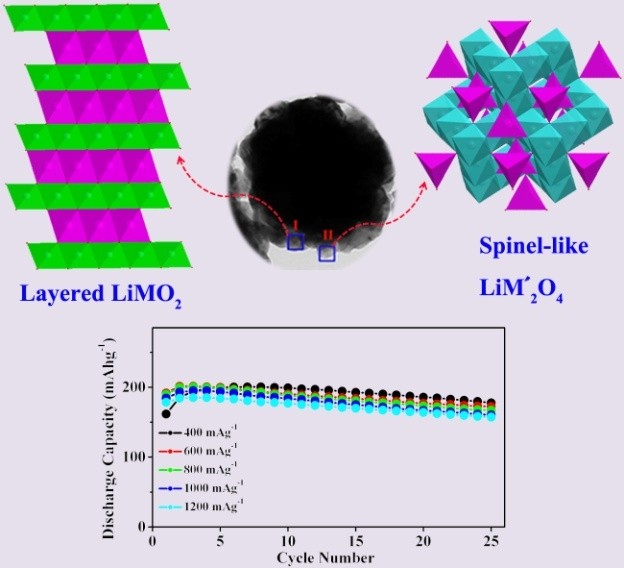
The research group headed by Prof. LI Lipingat Fujian Institute of Research on the Structure of Matter, Chinese Academy of Sciences, has designed a solvothermal-precursor method to synthesize spinel-layered Li-rich microspheres, by which a small amount of spinel component is successfully introduced into layered oxides.
Due to the introduction of spinel-like component which has the efficient three-dimensional diffusion of lithium ions, the surface-film and charge-transfer resistances of the spinel-layered Li-rich microsphere electrode material are decreased obviously, and the Li-ion diffusion coefficient of that has significantly increased. All of these are very helpful to improve the rate capability of Li-rich cathode materials.
It is amazing that with the aid of spinel-like component, the discharge capacityof the spinel-layered Li-rich microsphere electrode material is only slightly reduced when the charge-discharge current density increases from60 to 1200 mA g-1.Results of this study have been published as an article inAdv. Energy Mater.(2014, DOI: 10.1002/aenm.201400062).
Previously, Prof. LI's group had made a series of relevant progress on thenew type cathode materials of Li-ion batteries, such as: Li1.2Mn0.4Co0.4O2,Li[Li0.14Mn0.47Ni0.25Co0.14]O2,LiCo0.95Mn0.05O2, LiMn2O4, LiMnPO4, LiNi0.5Mn1.5O4and so on.Related research results published inJ. Mater. Chem. A (2014, 2, 1471;2013, 1, 9721;2013, 1, 1220) and J. Mater. Chem.(2012, 22, 22233).