Lithium-sulfur (Li-S) batteries are considered as one of the most promising energy storage systems because of their high theoretical capacity, high energy density, high natural abundance, and environmental friendliness of sulfur element. However, practical implementations of Li-S batteries are still impeded by several intrinsic problems, such as the insulating nature of sulfur/lithium sulfide (Li2S), inevitable shuttle effect of soluble polysulfides, and volume variation upon cycling. Therefore, it is a still formidable challenge that how to synchronously achieve high gravimetric, areal, and volumetric capacities together with high rate and cyclic stability performance under high sulfur content and high sulfur loading.
In a study published in Adv. Mater., a research group led by Prof. WANG Ruihu from Fujian Institute of Research on the Structure of Matter (FJIRSM) of Chinese Academy of Sciences reported one type of new heterostructure nanosheets (CoB/NBC) composed of cobalt boride (CoB) on nitrogen, boron-codoped porous carbon (NBC), as cathode materials applied in Li-S batteries.
The researchers constructed the CoB/NBC heterostructure nanosheet through molten salt-assisted strategy using ZIF-67-encapsulated ZIF-8 (ZIF-867) as precursors. During the annealing process in the molten salt medium, ZIF-867 goes through the dissolution-growth pathway, which promises the intimate adhesion between CoB and NBC components in CoB/NBC.
The Scanning electron microscopy (SEM) and transmission electron microscopy (TEM) images exhibit that dodecahedral polyhedron of ZIF-867 was fully transformed into nanosheets. The high-resolution TEM (HRTEM) image of CoB/NBC exhibits that CoB nanosheets are tightly adhered to the surface of NBC nanosheets to form the 2D heterostructure. In addition, the obvious shifts of binding energy in the B 1s and Co 2p X-ray photoelectron spectroscopy (XPS) spectrum further validate the existence of the interface interfacial electronic interaction between CoB and NBC.
Because of the strong interfacial electronic interactions between binary sulfiphilic CoB and porous NBC, CoB/NBC-S composite cathode offers the high specific capacity and excellent cycling stability performance in comparison with that in CoB-S and NBC-S. Remarkably, the electrode with high sulfur content of 82 wt% and high sulfur loading of 5.8 mg cm-2 (CoB/NBC-S-5.8) delivers gravimetric capacity of 1309 mA h g-1, areal capacity of 7.59 mA h cm-2, and volumetric capacity of 1355 mA h cm-3 at 0.1 C.
Through the density functional theory (DFT) calculations, the researchers found that the interfacial electronic interactions between NBC and CoB would induce charge redistribution at the interface region, which expedites ion/electron transport and uniform deposition of solid sulfur species. Moreover, the formation of heterostructure will enhance the adsorption energy of polysulfides toward CoB/NBC and reduce the decomposition activation energy of Li2S on CoB/NBC.
This study not only provides new methodology for the design of heterostructure nanosheets of metal borides, but also provides news insight into the understanding of the interfacial electronic effects for improving energy density and longevity of Li-S batteries. The protocol holds great promises for the development of advanced energy storage systems and electrocatalytic materials.
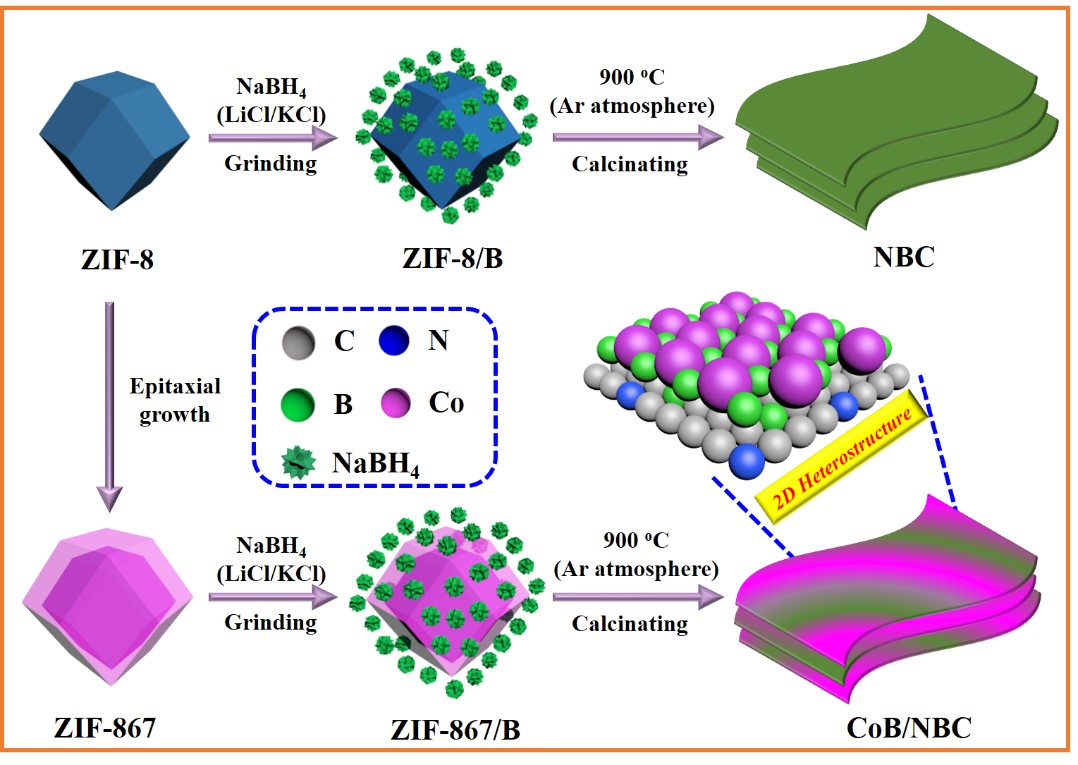
Schematic illustration for the synthesis of CoB/NBC. (Image by Prof. WANG's Group)
Contact:
Prof. WANG Ruihu
Fujian Institute of Research on the Structure of Matter
Chinese Academy of Sciences
E-mail: ruihu@fjirsm.ac.cn
