Second-order nonlinear optical (NLO) materials are of current interest owing to their uses in optical signal processing, and new laser sources based on the NLO processes of second-harmonic generation (SHG) and optical parametric oscillation. Although considerable progress has been made recently in the exploration of new NLO materials, many of them based on oxides such as the famous KH2PO4 (KDP), KTiOPO4 (KTP), b-BaB2O4 (BBO), LiB3O5 (LBO) and so on, which are widely used in visible and ultraviolet region, can not be used in mid- and far-IR region because of strong absorption. On the other hand, commercially available IR NLO materials like ZnGeP2 and AgGaS2 are not good enough for high power applications mainly due to their low laser damage thresholds, and most of the other IR NLO material systems are at the stage of laboratory research. Therefore, the search for new material systems with excellent IR NLO performance has become a key area of research in NLO material science and laser technology.
Prof. GUO Guocong and his colleagues at Fujian Institute of Research on the Structure of Matter (FJIRSM), Chinese Academy of Sciences (CAS), has made significant progress on the discovery of new IR NLO material systems based on the inorganic supramolecular compounds.
They succeeded in synthesizing two inorganic supramolecular compounds (Hg6P3)(In2Cl9) (1) and (Hg8As4)(Bi3Cl13) (2), which have chiral 3-D cationic host frameworks with guest anions filling the helical tunnels, by moderate-temperature solid-state reactions. They both have large SHG efficiencies compared to AgGaS2, and type-I phase-match at the wavelength of 2.1μm by the measurements of SHG signal as a function of particle size on the powder samples. Compounds 1 and 2 also have wide transparency range in IR region (0.6-25 mm at least), as well as suitable laser damage thresholds, indicating 1 and 2 may be good candidates for mid- and far-IR NLO materials and inorganic supramolecular compounds may be a new promising IR NLO material system. Theory studies of NLO properties for 1 and 2 show that both the host framework and anionic guest make comparable contribution to the NLO properties and the larger SHG efficiency of 2 than 1 results from the larger average bond orders of metal-nonmetal bonds in 2 than those in 1 (J. Am. Chem. Soc. 2011, 133, 3410-3418).
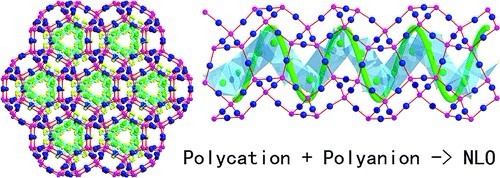
The research indicates that good IR NLO materials can be obtained by designing both complicated polycation and polyanion with large molecular polarizability as functional components rather than traditional single polyanion, and the spatial arrangement of the functional components can be designed in a reasonable alignment to enforce macroscopic dipole ordering efficiently through crystal engineering strategy.
