Trivalent lanthanide (Ln3+) doped inorganic nanocrystals (NCs) have been extensively regarded as a new generation of luminescent bioprobes, due to their superior features such as long luminescence lifetime, large Stokes shift, narrow emission band widths, low toxicity, and high resistance to photobleaching. Meanwhile, Gd ion has been extensively applied in magnetic resonance imaging contrast agents due to the seven single electrons. It would be quite attractive to combine the MRI with luminescence detection, realizing the in vivo bioimaging, tumor therapy, DNA sequence with high sensitivity and low diagnose.
The research group headed by Prof. CHEN Xueyuan at Fujian Institute of Research on the Structure of Matter(FJIRSM), Chinese Academy of Sciences, has proposed one novel strategy to realize the magnetic/optical multimodal bioapplication based on KGdF4:Ln3+ NCs. The detection sensitivity and signal-to-noise ratio have been greatly enhanced via utilizing the time-resolved detection method and the long-lived lifetime of Ln3+. They reported the fabrication of amine-functionalized cubic KGdF4:Ln3+ NCs by single-step solvothermal route, and achieved the detection of avidin through time-resolved fluorescence resonance energy transfer (TR-FRET) method with the detection limit of 5.5 nM. Besides, since single NC contains many Gd3+ ions, the relaxivity of KGdF4 NCs is 5.86 S–1·mM–1 which is higher than that of clinic applied Gd-DTPA (J. Am. Chem. Soc., 2012, 134, 1323).
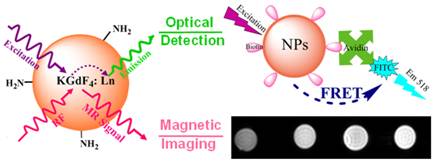
(Magnetic/optical multimodal bioprobes based on KGdF4:Ln3+ nanocrystals)
Previously, Prof. CHEN's group had also synthesized carboxyl-functionalized GdF3:Ln3+ magnetic/optical bimodal bioprobes, which can realize the heterogeneous time-resolved photoluminescence (TRPL) detection of avidin with the detection limit down to 74 pM (Chem. Eur. J., 2011, 17, 8549), and prepared amine-functionalized NaYF4:Ce/Tb NCs to detect 4.8 nM avidin with homogeneous TR-FRET method (Angew. Chem. Int. Ed., 2011, 50, 6306).
