Luminescent inorganic nanoparticles (NPs) doped with trivalent lanthanide (Ln3+) ions, emerging as a new class of bioprobes and as an alternative to conventional molecular probes, have attracted tremendous interest for their potential bioapplications. However, most of the previous efforts were restricted to the development of fluoride NPs like NaLnF4 and LnF3. Ultra-small Ln3+-doped inorganic oxide NPs, a new and huge family of luminescent bioprobes, remain nearly untouched, although they in principle possess better photostability and chemical stability. Presently, it is notoriously difficult and thus remains a challenge to synthesize ultra-small and biocompatible bioprobes based on oxide NPs.
The research groups leaded by Prof. CHEN Xueyuan and Prof. HUANG Mingdong at Fujian Institute of Research on the Structure of Matter(FJIRSM), Chinese Academy of Sciences, have developed a new inorganic oxide bioprobe based on sub-5 nm amine-functionalized tetragonal ZrO2:Ln3+ NPs synthesized via novel solvothermal and ligand exchange methods.
By utilizing the long-lived luminescence of Ln3+, they have demonstrated for the first time its application as a sensitive time-resolved (TR)-FRET bioprobe to detect avidin with a record-low detection limit of 3.0 nM. More importantly, they have also manifested its specific recognition capability for cancer cells over-expressed with urokinase plasminogen activator receptor (uPAR, an important marker of tumor biology and metastasis), which has never been explored in NP-based targeted imaging so far. These findings may open up new avenues for the exploration of Ln3+-doped oxide-based NPs in versatile bioapplications.
Results of this study have been published as an article in J. Am. Chem. Soc. (J. Am. Chem. Soc.,134, 15083,2012) and featured in the JACS Spotlights. This research work was then highly praised by Chemical & Engineering Newsof ACS headlined “Tiny, Brightly Glowing Nanoparticles Could Detect Disease Biomarkers”(Chemical & Engineering News, September 5,2012).
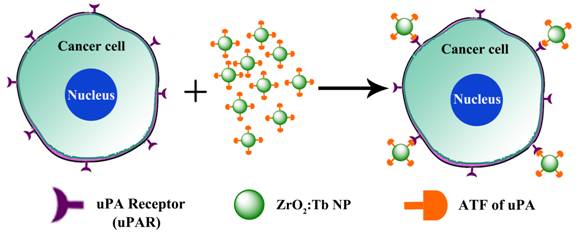
Figure 1: Lanthanide ions doped ultrasmall ZrO2 NPs for targeted cancer cell imaging (Image by Prof. CHEN Xueyuan's group)
Previously, Prof. CHEN's group had proposed one novel strategy to realize the magnetic/optical multimodal bioapplication based on KGdF4:Ln3+ NPs (J. Am. Chem. Soc., 2012, 134, 1323), and also proposed a unique upconversion (UC) luminescent mechanism termed as energy migration-mediated UC (Nature Mater., 10, 968,2011) in cooperation with Prof. LIU Xiaogang’s group in National University of Singapore.
Besides, Prof. CHEN’s group had also made much significant progress in Ln3+ ions doped other luminescent materials exemplified by KLaF4:Ln3+ NPs and YPO4:Yb3+,Tm3+ quantum cutting phosphors,which werefeatured as Front Cover (Nanoscale,4,4485,2012) and Inside Front Cover(Phys. Chem. Chem. Phys.,14, 6974,2012), respectively.
Contact:
Prof. CHEN Xueyuan
Fujian Institute of Research on the Structure of Matter
Chinese Academy of Sciences
Email: xchen@fjirsm.ac.cn
