Synergistic catalysis is a synthetic strategy wherein both the nucleophile and electrophile are simultaneously activated by two separate and distinct catalysts to afford a single chemical transformation. This powerful catalysis strategy can improve the efficiency of existing transformations and has attracted great interest in this area.
Prof. SONG Ling and her coworkers at Fujian Institute of Research on the Structure of Matter (FJIRSM), Chinese Academy of Science (CAS) explored the synergistic effect of achiral quaternary ammonium salt in asymmetric catalytic additions of diethylzinc to aldehydes.
With the use of chiral phosphoramide ligand as the catalyst which was designed and synthesized by themselves (J. Org. Chem.2012,77, 10427-10434), introducing 10 mol% NBu4Br into reaction system dramatically reduced the loading amount of chiral ligand from 10 mol% to 0.5 mol% without sacrificing excellent reactivity and enantioselectivity of this reaction, which still achieved high efficiency with only 0.1 mol% chiral ligand in the presence of 10 mol% NBu4Br. The interesting results of this study have been published in Tetrahedron Letters(2013,54, 2722-2725).
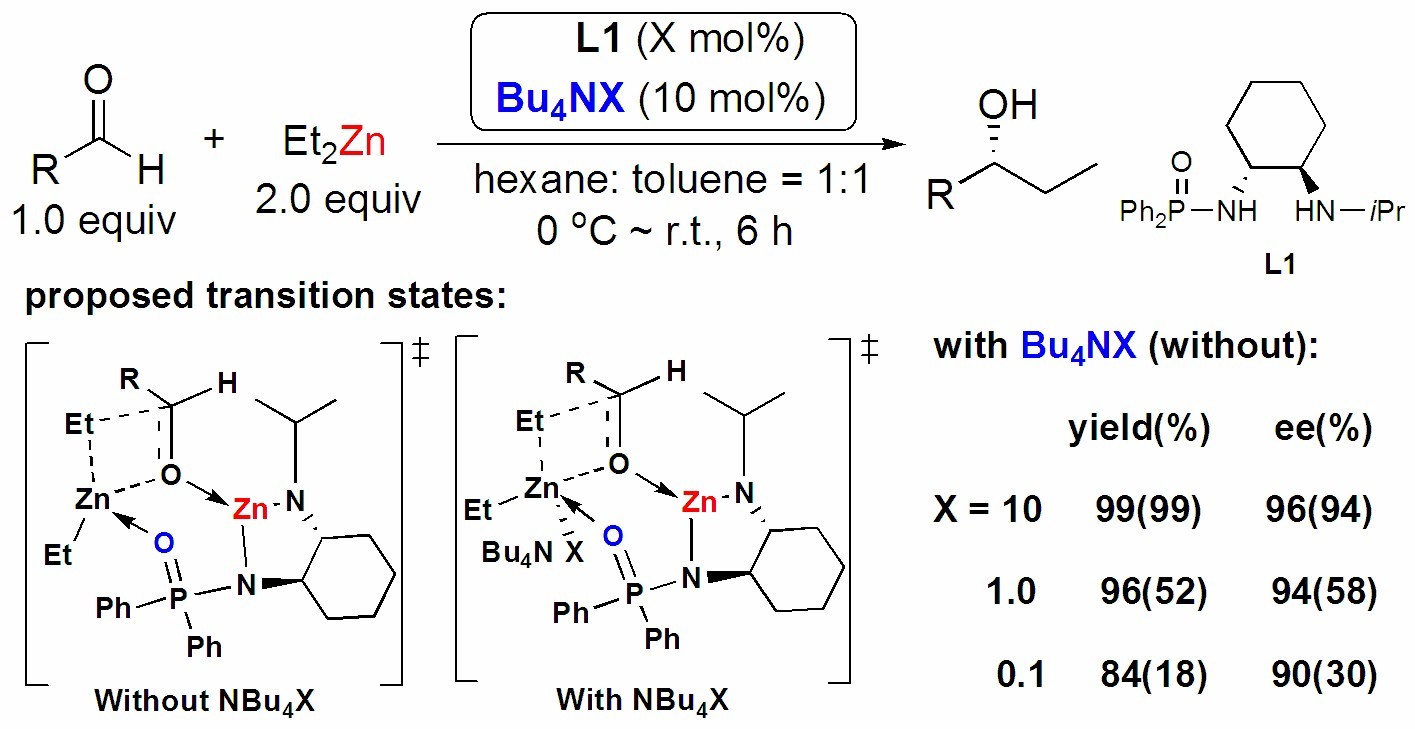
Synergistic effect of NBu4Br in asymmetric ethylation of aldehydes(Image by Prof. SONG Ling’s Group)
For most of these developed chiral catalytic systems, high loading amounts of chiral catalysts over 1 mol%, normally in the range of 10-20 mol %, are required to achieve synthetically useful results. Highly efficient catalytic systems for this reaction giving excellent yields and enantioselectivities of addition products with very low chiral catalyst loadings (< 1 mol%) are still rare.
Recently, this work was highlighted by SYNFACTS(2013,8, 873) in the part of metal-catalyzed asymmetric synthesis and stereoselective reactions.
Contact:
Prof. SONG Ling
Fujian Institute of Research on the Structure of Matter
Chinese Academy of Sciences
Email: songling@fjirsm.ac.cn
