Now, people are facing serious environmental pollution and energy shortage problems. Exploring high efficient, environment friendly heterogeneous catalytic materials for organic transformation is one of the hotspot fields on catalytic chemistry. The use of water as reaction medium in the heterogeneous activation of C-H bonds has numerous advantages in terms of environmental benign, safety and cost efficiency impact.
The research group headed by Prof. CAO Rong at Fujian Institute of Research on the Structure of Matter (FJIRSM), Chinese Academy of Sciences (CAS) has developed a series of efficient catalysts based on MOFs. They introduced perfluoroalkanes into the mesopores of metal-organic framework (MOF) NU-1000, which was employed as a hydrophobic platform to encapsulate ultrafine palladium nanoparticles (Pd NPs). The resultant Pd NPs exhibited high activity and regioselectivity in the direct C–H arylation of indoles in water. The paper was published on J. Catal., 2016, 333, 1-7, which was selected as Featured Article.
In addition, MOFs in most of the reported MOFs–imbedded metal NPs catalyst systems serve only as supports to protect NPs from agglomeration. Moreover, most MOFs are still largely restricted to microporous regimes, which limit the diffusion and mass transfer of the substrates and products. Here, we use hierarchically micro- and mesoporous MOFs for the first time to immobilize highly dispersed PtPd bimetallic alloy nanoparticles (NPs). The obtained composites as bifunctional catalysts based on the combination of MOFs and alloy NPs show synergistic enhanced catalysis of oxidant-free dehydrogenation of alcohols. The paper was published on J. Catal., 2015, 330, 452-457, which was also selected as Featured Article by the chief editor.
The team also successfully prepared Pd NPs encapsulated in the mesoporous cages of amine-functionalized MIL-101(Cr)–NH2, which exhibited high activities in the dehalogenation of aryl chlorides in water under mild conditions (J.Catal.2012,292,111). The Pd NPs supported on amine-functionalized, mixed-linker MIXMOFs based on MIL-53(Al) showed high activities in Heck reactions (ChemPlusChem,2012,77,106, Top Cited Articles). The Pd NPs supported on amine-functionalized MOF MIL-53(Al)-NH2 exhibited high activities in Suzuki reactions (Catal. Commun.,2011,14,27, Top Cited Articles). The Pd NPs encapsulated in the mesoporous cages of the MIL-101(Cr) showed extremely high activities in the direct C2 arylation of substituted indoles with iodobenzenes (Chem.Eur.J.,2011,17,12706). All the nanocatalysts are stable and can be easily recovered and reused several times without leaching into solution and loss of activity, which provides an alternative idea for development of new and efficient catalyst.
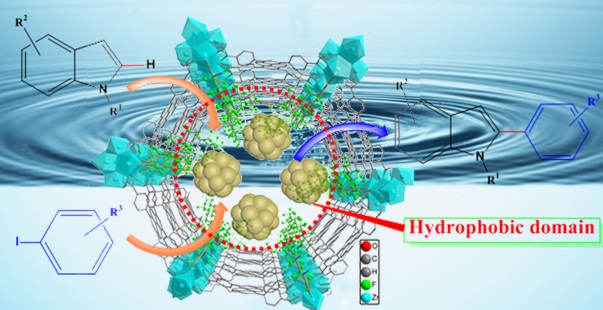
Water-medium C-H activation over a hydrophobic perfluoroalkanedecorated metal-organic framework platform (Image by Prof. CAO Rong's group)
Contact:
Prof. CAO Rong
Fujian Institute of Research on the Structure of Matter
Chinese Academy of Sciences
Email: rcao@fjirsm.ac.cn
