Motivated by the breakthrough of organic-inorganic hybrid perovskites (i.e. CH3NH3PbI3), two-dimensional (2D) perovskite hybrids have also taken a promising position in the field of photodetection.However, their relatively slow responding time (τ) is an obstacle for their practical device application.
Recently, Prof. LUO Junhua’s group at Fujian Institute of Research on the Structure of Matter of the Chinese Academy of Sciences constructed the ultrafast-responding photodetector using the 2D hybrid perovskite crystals. The result was published in Laser&Photonics Reviews.
Responding time is one crucial figure-of-merit for photodetectors and quick responding rate could broaden the application scope of photoelectric devices.
The lateral-structure photodetector based on single crystals of EMA shows an ultrafast responding time of ~1.5 μs, which is is faster by 2-4 orders than other 2D hybrid perovskites, and even quicker than some top-ranking inorganic perovskite competitors, including PbS nanoplates-graphene and CsPbBr3 nanosheets, etc.
Such ultrafast responding can be attributed to the high crystallinity and quite low density of defects and traps (~ 5.53×1010cm-3).
Besides, this device also exhibits extremely low dark current (~10-10 A) and large photocurrent on/off ratio (>103), revealing its potentials as high-efficiency photodetector.
This work highlighted the potentials of 2D perovskite hybrids for the ultrafast responding photodetection.
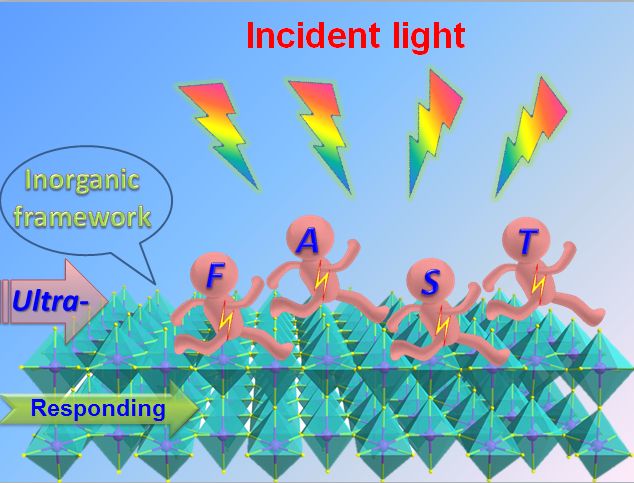
Schematic illustration of the photodetector based on perovskite crystal (Image by Prof. LUO’s group) .
Contact:
Prof. LUO Junhua
Fujian Institute of Research on the Structure of Matter
Chinese Academy of Sciences
Email: jhluo@fjirsm.ac.cn
