Molecular ferroelectrics have been recently developed as an important complementary for the traditional inorganic counterparts. However, it remains a challenge to achieve the fast switching of their spontaneous polarization.
In a study published in Angew. Chem., Int. Ed., a research team led by Prof. LUO Junhua at Fujian Institute of Research on the Structure of Matter of the Chinese Academy of Sciences designed a new molecular ferroelectric compound, N-methylmorpholinium trinitrophenolate , which shows the record-fast switching of spontaneous polarization.
N-methylmorpholinium trinitrophenolate is a room-temperature ferroelectric with notable spontaneous polarization of ~3.2 μc/cm2. Structural analyses reveal that the order-disorder changes of N- methylmorpholinium cation and trinitrophenolate anion afford the driving force to trigger its phase transition at 315 K.
This ferroelectric-to- paraelectric phase transition was solidly confirmed by variable-temperature second harmonic generation effect, pyroelectric and dielectric measurements, and solid-state NMR spectra, etc.
It is noteworthy that N-methylmorpholinium trinitrophenolate enables the highly-fast switching of polarization at room temperature. The rectangular P-E hysteresis loops were recorded under a high frequency up to 263 KHz, which is much superior to those found in the majority of organic ferroelectrics.
This work not only shed light on the design of new molecular ferroelectrics, but also opened up the possibilities for further applications of organic ferrioc materials.
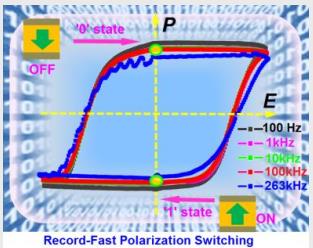
Schematic illustration of polarization switching in the molecular ferroelectric(Image by LUO Junhua et al.)
Contact:
Prof. LUO Junhua
Fujian Institute of Research on the Structure of Matter
Chinese Academy of Sciences
Email: jhluo@fjirsm.ac.cn
