Non-orthogonal multiple access (NOMA) is a key physical layer technology for 5th generation wireless communication systems, particularly for visible light communications (VLC). In conventional NOMA scheme, the LED-array-module is driven by a single circuit thus resulting in higher gain and bandwidth requirements for the driver circuit and suffering higher nonlinear transmission impairment.
A research team led by Prof. LIN Bangjiang and Prof. TANG Xuan at Fujian Institute of Research on the Structure of Matter, Chinese Academy of Sciences, have worked with optical power domain (OPD)-NOMA scheme for VLC.
In OPD-NOMA, LEDs are divided into a number of groups with each group being driven by a user with a particular driver circuit. The user messages are superposed in the optical power domain and decoded via a successive interference cancellation (SIC) based receiver.
The researchers found that the OPD-NOMA scheme incorporated all the attractive features of conventional PD-NOMA such as improved fairness, higher system throughput.
In addition, the maximum driven current for respective circuits was reduced thus reducing the gain-bandwidth product requirement for the driver circuit.
Researchers developed an experimental testbed to verify the feasibility of OPD-NOMA scheme. The experimental results showed that OPD-NOMA offered improved performance in terms of the average bit error rate (BER) compared to conventional NOMA using the same driver circuit with a limited gain-bandwidth product. This is because OPD-NOMA can make a better use of the linear dynamic range of the LED’s P-I response.
This study was published in IEEE Wireless Communications Letters.
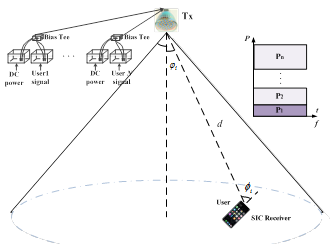
Optical Power Domain NOMA for Visible Light Communications. (Image by Prof. TANG’s Group)
Contact:
Prof. Lin Bangjiang
Fujian Institute of Research on the Structure of Matter
Chinese Academy of Sciences
Email: linbangjiang@fjirsm.ac.cn
