Two-dimensional(2D) hybrid double perovskite materials have the characteristics of non-toxicity, good stability, and easy growth of crystals, and they have shown excellent performance in photoelectric detection and high-energy ray detection. Moreover, 2D hybrid double perovskites have strong intrinsic anisotropy of structure, which makes it possible to realize polarized-light detection.
Up to now, the research of polarized-light photodetection based on 2D hybrid double perovskite materials still remains unexplored.
In a study published in Angew.Chem.Int.Ed., a research group led by Prof. LUO Junhua and Prof. SUN Zhihua from Fujian Institute of Research on the Structure of Matter (FJIRSM) of Chinese Academy of Sciences, reported a distinct hybrid double perovskite compound, (i-PA) 2CsAgBiBr7 (i-PA is isopentylammonium) with a unique 2D quantum-confined structure.
The researchers found that distinct from the isotropic structure of three-dimensional (3D) Cs2AgBiBr6, (i-PA)2CsAgBiBr7 has a strong intrinsic anisotropy of structure, which endows it highly anisotropic nature of physical properties, including electric conductivity and optical absorption.
(i-PA)2CsAgBiBr7 presents an obvious anisotropy of optical absorption (the ratio αb/αc = 1.9 at 405 nm), which is beneficial to achieve polarized-light detection. Under the 405 nm laser illumination, photocurrent is dependent on the polarization angle, following a sine function in the polar coordinate, and (i-PA)2CsAgBiBr7 shows excellent polarization-sensitive responses with the large dichroic ratios up to 1.35, which is higher than that of the known 2D GeSe (the dichroic ratios is 1.09).
Besides, the crystal device based on (i-PA)2CsAgBiBr7 exhibits polarized light response speed as fast as 200 ms, and excellent repeatability and stability of the polarized light response switch.
This is the first study of 2D hybrid double perovskites with strong polarization sensitivity. These results reveal that hybrid double perovskites have a great research potential on new functionalities for future optoelectronic application.
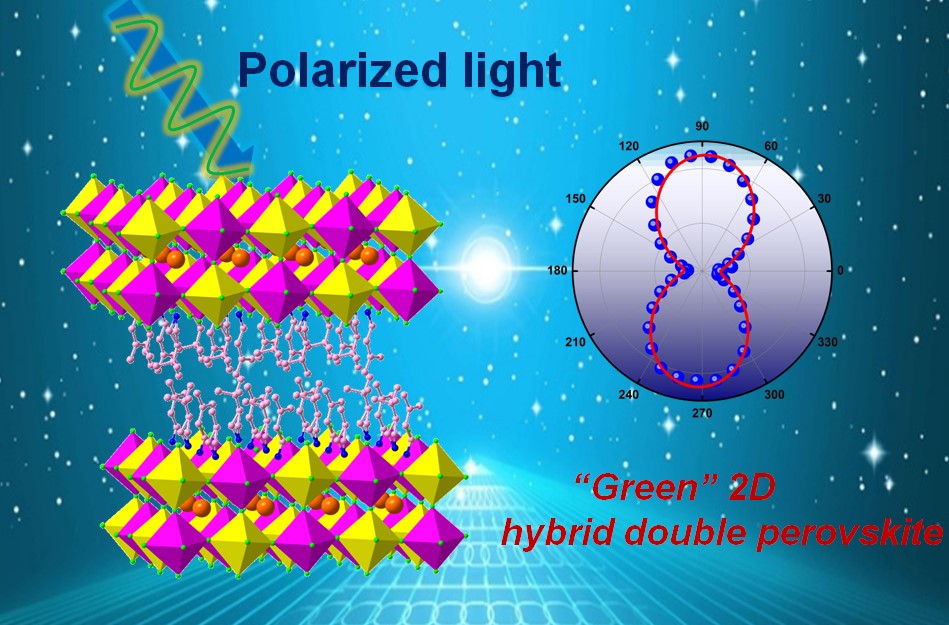
Schematic illustration of (i-PA)2CsAgBiBr7 under polarized-light illumination ((Image by Prof. LUO’s group).
Contact:
Prof. SUN Zhihua
Fujian Institute of Research on the Structure of Matter
Chinese Academy of Sciences
E-mail: sunzhihua@fjirsm.ac.cn
