Well-defined metal complexes with chemical stability and structural tunability are a promising class of electrocatalytic CO2 reduction (ECR) catalysts, especially immobilized metal phthalocyanines. However, the strong intermolecular π-π stacking interactions of non-substituted metal phthalocyanines usually result in overt aggregation, low solubility, and thus generally un-controllable assembly on the support surface with uneven and multilayered deposition, severely reducing the accessible active sites.
Therefore, the development of the non-aggregated metal phthalocyanine catalysts with controllable assembly behaviors and tunable surface wettability for achieving excellent ECR performance is still a challenge.
In a study published in Applied Catalysis B: Environmental, a research group led by Prof. ZHU Qilong from Fujian Institute of Research on the Structure of Matter (FJIRSM), Chinese Academy of Sciences, reported an extremely active and selective immobilized pyrrolidinonyl nickel phthalocyanine (PyNiPc) catalyst for ECR.
The catalyst was constructed by a built-in pyrrolidone group-assisted assembly/fixation strategy and presented single-molecular level dispersion of PyNiPc on carbon nanotubes to achieve the high surface density of Ni-N4 active sites.
The researchers found that the resulting catalyst (PyNiPc/CNT) can predominantly produce CO in the electrocatalytic CO2 reduction, affording nearly 100% Faradaic efficiency over a wide potential range, especially obtaining the ultrahigh CO/H2 volume ratios up to 640 at –0.88 V vs. (reversible hydrogen eletrode )RHE.
Besides, they found that after continuous chronoamperometry test at the overpotential of 0.67 V for 10 h, the current density and Faradaic efficiency for CO were not significantly reduced.
Furthermore, the experimental results indicate that the high activity of PyNiPc/CNT for ECR originates from the single-molecularly Interfacial synergy-catalysis between PyNiPc and CNTs and the built-in pyrrolidone groups also play an important role in promoting phthalocyanine dispersion and catalysis.
The study presents a new strategy to make the best of the excellent intrinsic activity of nickel phthalocyanine and provide valuable guides for the development of efficient and stable electrocatalysts for CO2 reduction and other electrochemical techniques.
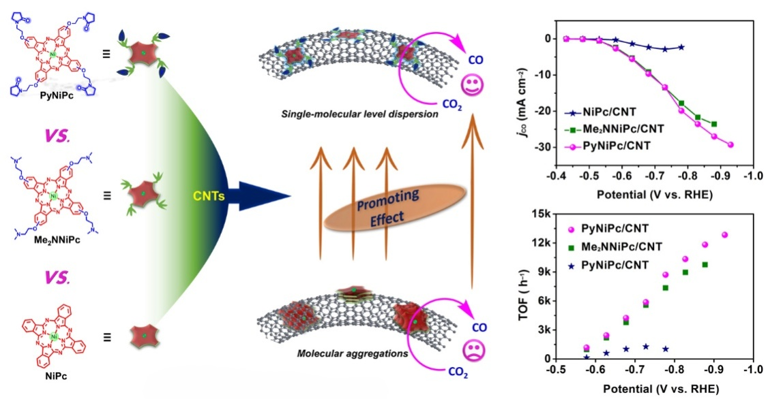
Schematic illustration of the proposed promotion effect of pyrrolidone groups in dispersion and catalysis (Image by Prof. ZHU’s group)
Contact:
Prof. ZHU Qilong
Fujian Institute of Research on the Structure of Matter
Chinese Academy of Sciences
Email: qlzhu@fjirsm.ac.cn
