Electrocatalysis, as a new type of sustainable energy conversion technology, has attracted extensive attention in recent years. Transition metal-nitrogen-carbon (M-N-C) catalysts with highly active metal–nitrogen (M–Nx) sites well-dispersed in the carbon matrices have proven to be very promising for various electrocatalytic reactions.
However, M-N-C catalysts are usually obtained from transition metal- and nitrogen-containing precursors through the pyrolysis process, which may generally lead to the formation of aggregated metal and metal oxide/carbide nanoparticles (NPs) under the harsh conditions. Therefore, powerful control means for the synthesis of the M-N-C catalysts are usually needed.
In a study published in Applied Catalysis B: Environmental, a research group led by Prof. ZHU Qilong from Fujian Institute of Research on the Structure of Matter (FJIRSM) of the Chinese Academy of Sciences, reported a novel metal–organic framework (MOF) derived Fe-N-C catalyst with distinctive mesoporous nanostructure and abundant Fe–Nx active sites.
The researchers fabricated the catalyst, which features as uniform porous carbon nanoframes with large mesopores (~10 nm) and a high density of atomically dispersed Fe–Nx active sites, from predesigned Zn–Fe bimetallic zeolitic imidazole framework (ZnFe-ZIF) by a facile way. Particularly, the iron ions act as both the mesopore-forming agent and the source of catalytically active sites during the pyrolysis process.
The existence of abundant large mesopores in the catalyst could not only greatly enhance the mass transport, but also make more active sites readily accessible to the reactants during the electrocatalytic process.
They found that the catalyst exhibited exceptional bifunctional electrocatalytic performances for oxygen reduction reaction (ORR) and electrochemical carbon dioxide reduction (ECR), and remarkable applications in Zn–air battery, outperforming the benchmark noble metal-based catalyst.
The study presents a new strategy to design and preparation of highly efficient single-atom non-noble metal catalysts, and provides an important reference for the development of novel catalysts with high electrocatalytic activities.
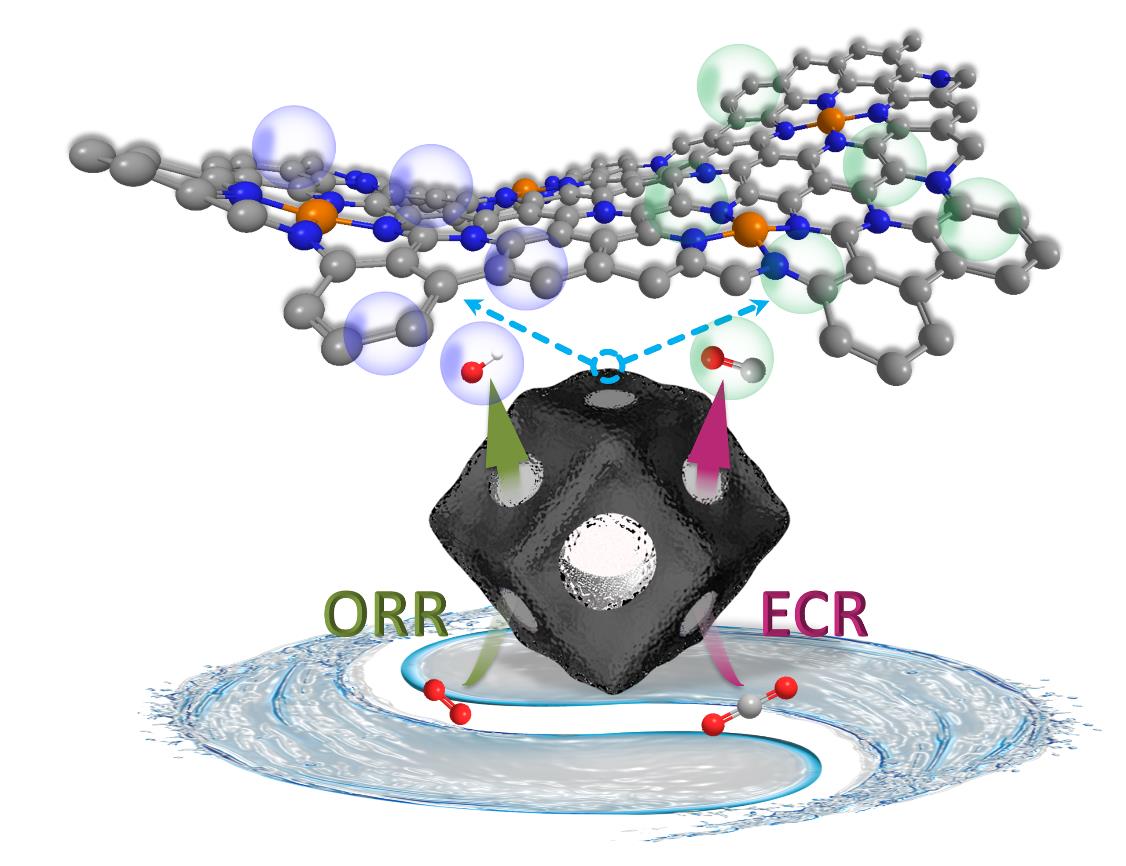
Schematic illustration of the research (Image by Prof. ZHU’s group)
Contact:
Prof. ZHU Qilong
Fujian Institute of Research on the Structure of Matter
Chinese Academy of Sciences
Email: qlzhu@fjirsm.ac.cn
