All-inorganic cesium lead halides (CsPbX3, X=Cl, Br, I) nanocrystals (NCs) have drawn tremendous attention worldwide due to their intriguing optoelectronic properties such as large absorption coefficient, high photoluminescence (PL) quantum yield (QY), narrow emission band, and tunable bandgap.
Great endeavors have been devoted to the controlled synthesis, luminescence mechanism and applications of CsPbX3 NCs. Despite the brilliant achievements in the past few years, these studies were mainly restricted to the visible spectral region, and there haven't been any studies on ultraviolet (UV)-emitting all-inorganic halide perovskites.
In a study published in Angewandte Chemie International Edition, a research group led by Prof. CHEN Xueyuan from Fujian Institute of Research on the Structure of Matter (FJIRSM) of Chinese Academy of Sciences proposed a unique strategy for designing UV-emitting luminescent all-inorganic halide perovskites by engineering the bandgap and surface structure of CsPbCl3 NCs.
The PL emission of CsPbCl3 NCs can be manipulated to the UV region with an emission peak at 381 nm by doping with Cd2+ without altering their morphology and crystal structure. The PL intensity of CsPbCl3:Cd2+ NCs can be increased by 19.5 times upon treatment with CdCl2. Correspondingly, their  PLQY was remarkably enhanced from 0.9% up to 60.5% by virtue of the surface passivation with CdCl2.
Meanwhile, the photostability was markedly improved as well. Upon continuous excitation with a 330-nm lamp (8 W), the pristine CsPbCl3:Cd2+ NCs exhibited negligible PLQY (< 0.1%) after 7 days. By contrast, the PLQY of the surface passivated CsPbCl3:Cd2+ NCs remained 50.5%.
Furthermore, by means of PL decays, femtosecond transient absorption analysis, and first-principle calculations through cooperation with Prof. DENG Shuiquan, the researchers unveiled the PL enhancement mechanism.
They demonstrated that the PL enhancement may be caused by the significant reduction of surface defects like chloride vacancy (VCl), which may cause deleterious nonradiative recombination.
This study provides a general approach for the design of highly efficient UV luminescent halide perovskite NCs, thereby opening up a new avenue for the exploitation of high-performance optoelectronic devices towards versatile applications such as lasers and LED devices.
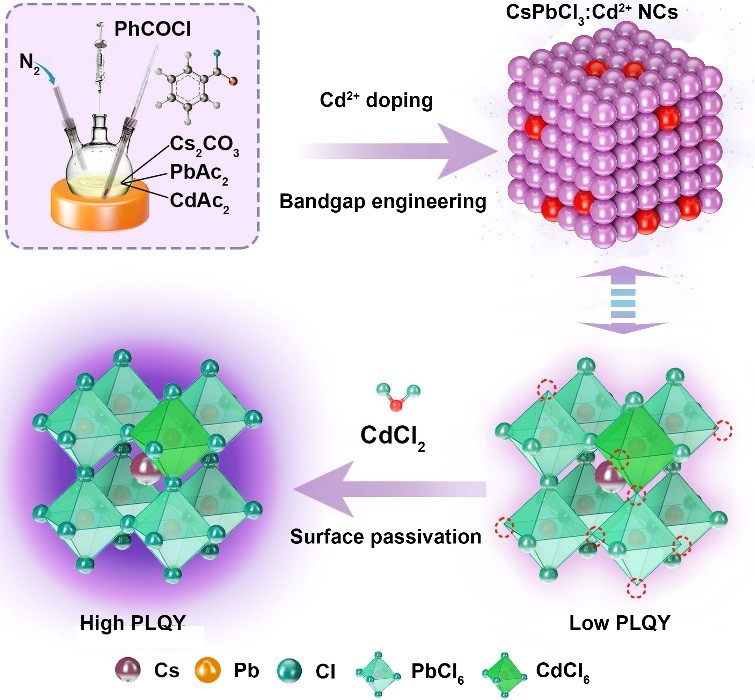
Schematic illustration for engineering the bandgap and surface structure of CsPbCl3 NCs to achieve highly efficient UV luminescence (Image by Prof. CHEN’s group).
Contact:
Prof. CHEN Xueyuan
Fujian Institute of Research on the Structure of Matter
Chinese Academy of Sciences
Email: xchen@fjirsm.ac.cn
