Cesium lead halide (CsPbX3, X=Cl, Br, I) perovskite nanocrystals (PeNCs) have drawn extensive attention in the fields of optoelectronics and photovoltaics due to their outstanding photophysical properties, such as long carrier diffusion distance, high photoluminescence (PL) quantum yield (QY), narrow emission bandwidth, and composition-dependent tunable bandgap and PL emission.
In contrast to individual PeNCs, perovskite nanocomposites, which integrate the advantages of PeNCs and other functional nanomaterials, hold great promise in areas as diverse as nanophotonics, photocatalysis, and biosensing. However, due to the ionic crystal nature and the high reactivity of halide anion in the perovskite system, it remains a challenge to control over CsPbX3 perovskite nanocomposites at a single particle level.
In a recent study published in NanoToday, the research group led by Prof. CHEN Xueyuan from Fujian Institute of Research on the Structure of Matter of the Chinese Academy of Sciences reported a unique photoinduced method for the controlled synthesis of CsPbX3 PeNCs and nanocomposites based on the light-triggered breakage of the covalent carbon-halogen bond of haloalkanes.
For synthesizing CsPbX3 PeNCs, Cs and Pb(II) oleate precursors were dispersed in tetrachloromethane (TCM), dibromomethane (DBM), 2-iodopropane (IDP), and the researchers used the mixed TCM/DBM and DBM/IDP as the solvent and the halide source. The photoreactive haloalkanes can release halide anions upon photoactivation, which react with Cs+ and Pb2+ ions in the solvent, followed by the formation of CsPbX3 PeNCs at room temperature.
In comparison with the conventional methods for synthesizing CsPbX3 PeNCs such as hot-injection and supersaturated recrystallization, the photoinduced method is much more gentle with an extremely slow reaction rate owing to the use of inactive haloalkanes as the halide source. This feature enables in situ confined growth of CsPbX3 PeNCs in mSiO2 nanospheres at a single particle level with well-defined morphology. As a result, CsPbBr3@MSNSs with different sizes of CsPbBr3 PeNCs can be synthesized through the photochemical route by varying the pore size of the pristine MSNSs.
Through photoinduced confined growth of CsPbX3 PeNCs in mSiO2 coated upconversion nanoparticles (UCNPs), the researchers achieved the controlled synthesis of monodispersed and uniform UCNPs@mSiO2@CsPbX3 core/shell nanoarchitectures with efficient upconversion luminescence from both lanthanides and PeNCs. Upon excitation with a 980-nm diode laser, UCNPs@mSiO2@CsPbBr3 exhibited strong UCL from Tm3+ and the band-edge exciton emission of CsPbBr3.
Specifically, the UCL lifetime of the CsPbBr3 excitons was enormously lengthened to 591 μs in UCNPs@mSiO2@CsPbBr3, in marked contrast to their intrinsic PL lifetime of 5.8 ns under 365-nm excitation. Such a long exciton lifetime of CsPbX3 along with efficient upconverted exciton emission in UCNPs@mSiO2@CsPbX3 adds new spectral and temporal dimensions to lanthanides for UCL and lifetime tuning, which is highly desirable for optical coding and multilevel anticounterfeiting.
This study provides a general approach for synthesizing CsPbX3 PeNCs and nanocomposites, which may open up new opportunities for perovskite-based material or device engineering towards versatile applications such as solar cells, LEDs, and photocatalysis.
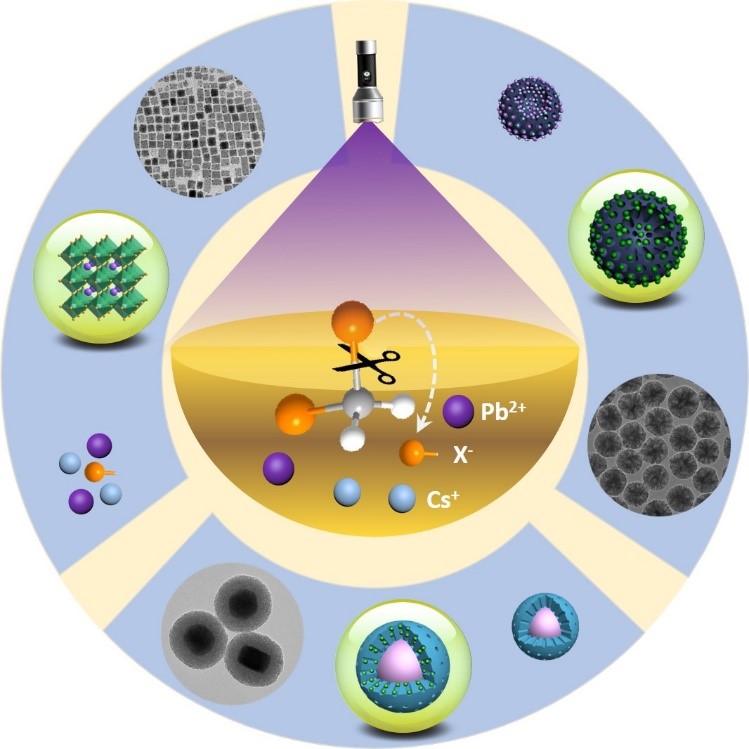
Schematic illustration of photoinduced synthesis of lead halide perovskite nanocrystals and nanocomposites. (Image by Prof. CHEN’s Group)
Contact:
Prof. CHEN Xueyuan
Fujian Institute of Research on the Structure of Matter
Chinese Academy of Sciences
Email: xchen@fjirsm.ac.cn
