The electrocatalytic conversion of CO2 into value-added chemicals using renewable electricity is a promising approach to reduce atmospheric CO2 concentration and realize carbon-energy balance. However, the low current density still limits CO2 electroreduction reaction (CO2RR) for commercial application.
Crystalline porous metal-organic frameworks (MOFs) are one class of promising alternatives for CO2RR due to their high CO2 adsorption uptakes and periodically arranged isolated metal active sites. However, the poor conductivity and slow electron-transfer capability of the traditional MOFs usually result in low current density in CO2RR.
In a study published in Angew. Chem. Int. Ed., Prof. CAO Rong and Prof HUANG Yuan-Biao from Fujian Institute of Research on the Structure of Matter (FJIRSM) of the Chinese Academy of Sciences (CAS) constructed one type of conductive two-dimensional phthalocyanine-based MOF nanosheets (NiPc-NiO4).
The researchers heated nickel phthalocyanin-2,3,9,10,16,17,23,24-octaol (NiPc-OH) and Ni(OAc)2′4H2O in water at 85 °C for 24 h, and fabricated ultrathin 2D NiPc-NiO4 nanosheets by exfoliating from its bulk via high-frequency sonication at room temperature.
As expected, the researchers found that the electrical conductivity of NiPc-NiO4 has a high value of 4.8 × 10⁻⁵ S m-1 measured at room temperature using a two-contact probe method. Such good electrical conductivity would be beneficial for the electron transfer to the active sites during CO2RR, thereby improving energy conversion efficiency and electrochemical activity.
The as-prepared 2D NiPc-NiO4 nanosheets showed outstanding activity towards CO2 electroreduction with nearly 100% CO selectivity, large CO partial current density up to 34.5 mA cm-2, high turnover frequency up to 2603 h-1, and excellent long-term durability. Such high turnover frequency (TOF) and CO partial current density is higher than any state-of-the-art MOF catalysts.
The density functional theory calculation proved that the nickel of phthalocyanine center is the active sites and NiPc-NiO4 performs better activity than the phthalocyanine molecules due to the fast electron transfer capacity and excellent reducibility, which is consistent with the experiment results.
This study provides an effective way to improve the CO2 electroreduction performance by designing conductive crystalline frameworks with uniformly distributed phthalocyanine active sites. It also builds a bridge between the homogeneous molecule catalysts and heterogeneous porous catalysts.
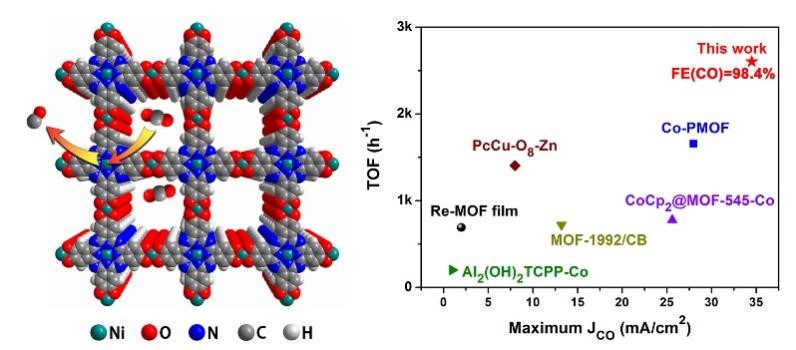
Nickel phthalocyanine molecules as active sites were installed into 2D conductive metal-organic framework nanosheets for efficiently CO2 electroreduction reaction with nearly 100% CO selectivity(Image by Prof. CAO’s group)
Contact:
Prof. CAO Rong
Fujian Institute of Research on the Structure of Matter
Chinese Academy of Sciences
Email: rcao@fjirsm.ac.cn
