 Lanthanide-doped upconversion nanocrystals (NCs) are promising candidates for various innovative bioapplications, Tb3+-doped energy migration upconversion (EMU) NCs are the most prominent ones.
Aiming at acquiring strong EMU emissions, in the traditional design scheme of Tb3+-doped EMU NCs, the sensitizer Yb3+ and accumulator Tm3+ ions are co-doped in the inner core, and the activator Tb3+ ion is spatially confined in the shell of NC. However, in vivo bioapplications based on such kind of Tb3+-doped EMU NCs are confronted with the dilemma of background biofluorescence, which is induced by the ultraviolet upconversion emissions of Tm3+ that are always of considerable magnitude concomitant with the EMU emissions of Tb3+.
In a recent study published in CCS Chemistry, the research group led by Prof. CHEN Xueyuan from Fujian Institute of Research on the Structure of Matter (FJIRSM) of the Chinese Academy of Sciences (CAS) reported a novel sandwich structure core@shell@shell scheme for the design of EMU NCs, wherein Yb3+, Tm3+, and Tb3+ were separately incorporated into the inner core, middle shell, and outer shell of NC, respectively.
In comparison with the traditional non-sandwich structure NaLuF4:Yb/Gd/Tm@NaGdF4@NaLuF4:Tb NCs, the sandwich structure NaLuF4:Yb/Gd@NaGdF4:Tm@NaLuF4:Tb NCs showed a great superiority in acquiring strong upconversion emissions of Tb3+, while nearly completely suppressing the Tm3+ ultraviolet upconversion emissions.
Specifically, under 980 nm excitation at a moderate powder density (~ 200 W/cm2), the intensity ratio between the strongest emission band of Tb3+ and the maximum ultraviolet emission of Tm3+ reached a value of ~ 58.9 for the sandwich structure NCs, largely exceeding the small value of less than 1.2 for the non-sandwich structure NCs counterparts.
Based on the steady-state and transient photoluminescence spectroscopy analyses, the researchers unveiled that the depressed random energy hopping between Gd3+ ions, in combination with the effective Gd3+→Tb3+ inter-shell energy transfer that largely enhanced the Yb3+–Tm3+ five-photon upconversion and subsequent Tm3+ to Gd3+ energy transfer processes, were responsible for the more remarkable EMU emissions of Tb3+ in the sandwich structure NCs.
This study presents a substantial advance as compared to previous work by providing a prototypical sandwich structure NaLuF4:Yb/Gd@NaGdF4:Tm@NaLuF4:Tb NC to circumvent the issue of background biofluorescence induced by the ultraviolet upconversion emissions of Tm3+ for the in vivo bioapplications based on Tb3+-doped EMU NCs. This finding may attract the great attention of a broad readership interested in the fundamental upconversion mechanism involving energy management on the nanometer-length scale in lanthanide-doped NCs.
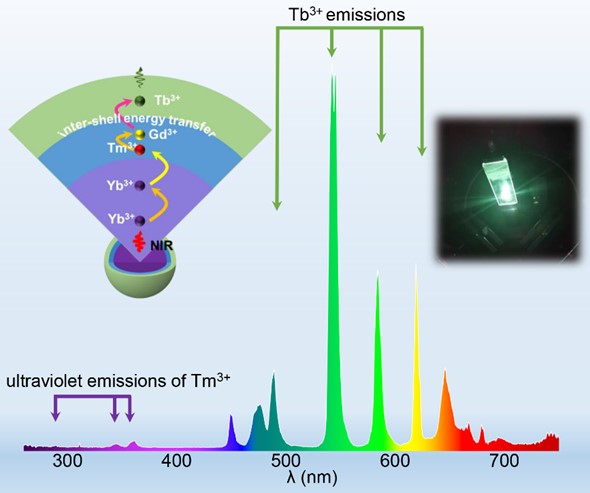
Schematic illustration of the sandwich structured core@shell@shell design strategy of EMU NCs for acquiring nearly completely inhibited Tm3+ UV upconversion emissions in parallel with the strong EMU emissions of Tb3+. (Image by Prof. CHEN’s Group)
Contact:
Prof. CHEN Xueyuan
Fujian Institute of Research on the Structure of Matter
Chinese Academy of Sciences
Email: xchen@fjirsm.ac.cn
