Emerging infectious diseases caused by special pathogens pose serious public health problems in worldwide. The current outbreak of COVID-19 epidemic is a devastating example. Equally worrisome is the rising prevalence of resistant bacteria, which could yet be another crisis. The overuse of antibiotics has resulted in a large number of bacteria developing resistance to one or more varieties of antibiotics. These resistant bacteria are much more difficult to treat and associated with high morbidity and mortality. Therefore, it is imperative to develop treatment alternatives that are able to combat resistant-bacteria effectively and avoid new resistance.
NIR-triggered antimicrobial photodynamic therapy (PDT) by lanthanide-doped upconversion nanoparticles (UCNP) as energy donor exhibits the advantages of high tissue penetration, broad antibacterial spectrum and less acquired resistance, but is still limited by its low efficacy. Once reactive oxygen species (ROS) fail to completely eliminate the bacteria, the residue bacteria will proliferate after PDT treatment.
In a study published in Angew. Chem. Int. Ed., the research group led by Prof. CHEN Xueyuan from Fujian Institute of Research on the Structure of Matter (FJIRSM) of the Chinese Academy of Sciences (CAS) realized synergistic lysozyme-photodynamic therapy against resistant bacteria in deep-tissue.
Researchers designed an intelligent bio-inorganic nanohybrid to integrate the enzymatic-photodynamic effect against resistant bacteria. In this nanohybrid, hierarchical coating of dense silica and dendritic mesoporous silica on UCNP provided effective loading of methylene blue (MB) as photosensitizer and macromolecular LYZ, respectively.
A bacterial hyaluronidase (HAase)-responsive valve was further mounted on the particle surface based on layer-by-layer (LBL) assembly of hyaluronic acid (HA) and poly-L-lysine (PLL) to realize intelligent release of LYZ.
The resulting nanohybrid had a strong disinfecting effect against methicillin-resistant Staphylococcus aureus (MRSA) (>5 log10 reduction of bacterial viability). More significantly, the researchers achieved excellent therapeutic efficacy against deep-tissue (5 mm-thick) MRSA infections without causing any side effects in murine model.
The researchers further examined the mechanism of nanohybrid, demonstrating a high affinity towards bacteria, rapid response and the synergistic effect via LYZ disrupting of the cell wall and exposing the bacteria to ROS.
This synergistic LYZ-PDT strategy is superior to the simple PDT treatment, which not only improves the bactericidal efficiency, but also prolongs the antibacterial activity, so as to eliminate infection and avoid recurrence.
This study may open up a new avenue for the exploration of efficiently synergistic anti-resistant bacterial agents.
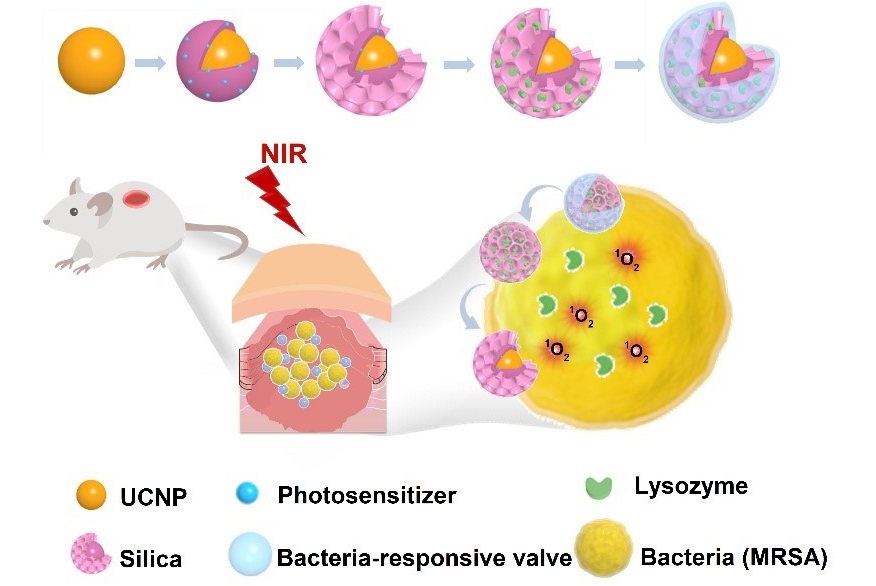
Schematic representation of antibacterial nanohybrid based on synergistic enzymatic-photodynamic effect (Image by Prof. CHEN’s Group)
Contact:
Prof. CHEN Xueyuan
Fujian Institute of Research on the Structure of Matter
Chinese Academy of Sciences
Email: xchen@fjirsm.ac.cn
