Flexible sensors are widely used in health diagnosis, motion monitoring, and human-computer interaction due to their excellent tensile properties, electrical conductivity and fit.
However, due to the inherent viscoelasticity of soft materials, the flexible sensor cannot quickly recover to its original shape during dynamic loading, resulting in a large hysteresis in the signal of the flexible sensor, which seriously affects the monitoring accuracy of the flexible sensor. How to quickly and accurately fabricate flexible sensors with low hysteresis remains a challenge.
In a study published in Chem. Eng. J., the research group led by Prof. WU Lixin from Fujian Institute of Research on the Structure of Matter (FJIRSM) of the Chinese Academy of Sciences, developed high resilience, low hysteresis and versatile porous flexible sensor by photocurable 3D printed ionogel.
Based on hydrogen bond-rich acrylate monomers and ionic liquids, the researchers prepared a photosensitive resin with fast polymerization rate for DLP printing of porous ionogel flexible sensors (PIFS), and a deformable IWP lattice was introduced in PISS structure to improve the resilience of the flexible sensor.
The experimental results show that after 500 cyclic compressions with a strain of 70%, the residual strain of the lattice-structured PIFS is almost 0, and the hysteresis loops are almost overlapped, showing that the PIFS has excellent resilience and fatigue resistance.
High elasticity and durability enable PIFS to have low hysteresis (2.4%), providing reliable sensing signals during long-term cyclic loading. The introduction of lattice structure also makes PIFS have higher pressure sensitivity (0.45 kPa-1).
The researchers also took advantage of the freely designable structure of 3D printing technology to design and print PIFS with customized structures for monitoring pulse, finger, gait and wrist movements.
In addition, PIFS has a low glass transition temperature (-45.8 °C) and can work stably in a low temperature environment. At the same time, PIFS also has antibacterial properties and rapid response to temperature changes, which can monitor temperature changes, demonstrating that PIFS is a versatile flexible sensor.
This study solves the hysteresis problem of flexible sensors by designing lattice structures in the sensor using 3D printing technology.
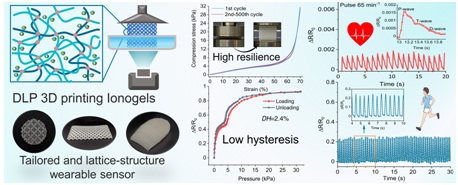
Schematic of the high resilience, low hysteresis and versatile sensors as wearable devices for motion monitoring (Image by Prof. WU’s group)
Contact:
Prof. WU Lixin
Fujian Institute of Research on the Structure of Matter
Chinese Academy of Sciences
E-mail: lxwu@fjirsm.ac.cn
