Hafnium (Hf) has no independent ore in nature, it always closely symbiotic with zirconium (Zr) in a homogeneous form, and accounts for only approximately 2% of Zr.
Zr and Hf have similar physical and chemical properties. Their nuclear properties such as neutron absorption cross section are completely opposite. Besides, Zr and Hf have similar outer electronic structures, and due to the shrinkage of the lanthanide series, the atomic radius and ionic radius differ only slightly. Therefore, the separation of Zr and Hf, especially the enrichment of Hf, is very difficult.
In a study published in Journal ofMembrane Science, the research group led by Prof. YANG Fan from Fujian Institute of Research on the Structure of Matter of the Chinese Academy of Sciences developed an advanced ion-imprinted membranes (IIMs) separation system to achieve highly efficient separation and enrichment of Hf.
The researchers prepared ion-imprinted membranes (IIMs) using Hf ions as the imprinted ion, N, N-di-2-ethylhexyl diglycolamic acid (D2EHDGAA) as the carrier molecule, and cellulose triacetate (CTA) as the base polymer, and IIMs were applied to the separation and enrichment of Hf from zirconium oxychloride solution.
They found that IIMs can increase CHf/CZr from 2.33:100 to 33.33:100 within 1 h compared with polymer inclusion membranes (PIMs) and ionic liquid supported liquid membranes (SLMs), which increased by 3.33 and 3.67 times, and the separation factor (SF) was increased by 1.13 and 1.40 times, respectively. The recovery rate of Hf was 29.2%, and separation-regeneration cycle experiments showed that the stability of IIMs was relatively good.
Besides, the researchers also revealed that IIMs, PIMs and SLMs can selectively separate and extract Hf ions in zirconium oxychloride solution, and the selectivity to Hf decreases in the order of IIMs > PIMs > SLMs. This selectivity is mainly attributed to the mutual structural matching between the imprinted holes of IIMs and Hf template ions and the complementary functional groups.
This study suggests that IIMs, as a new idea for the efficient separation and enrichment of Hf from zirconium oxychloride solution, may have good potential for industrial application.
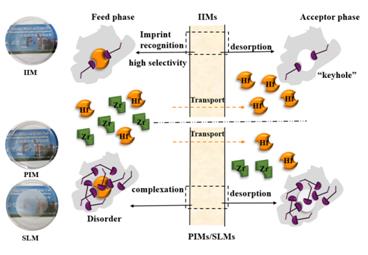
Schematic diagram of the transport mechanism through the membrane system(Image by Prof. YANG’s group)
Contact:
Prof. YANG Fan
Fujian Institute of Research on the Structure of Matter
Chinese Academy of Sciences
Email: fanyang2013@fjirsm.ac.cn
