In the permanent magnet synchronous motor (PMSM) driving system, continuous-control -set (CCS) type predictive control strategy is focused due to its good control accuracy and excellent dynamics.However, due to the weak robustness of the common predictive control, its applications are severely restricted in the high-end manufacturing field.
To solve this issue, model-free predictive control based on a data-driven model is used in the motor driving system. The clarity of the sampled data is one of the key influences on the model accuracy since the control performances of this control strategy are directly affected by model accuracy.
In a study published in IEEE Transactions on Power Electronics, Prof. WANG Fengxiang’s group from Fujian Institute of Research on the Structure of Matter of the Chinese Academy of Sciences analyzed the generating reasons for the harmonics caused by the control strategy itself, and designed a continuous-control-set model-free predictive fundamental current control strategy for PMSM system to solve this problem.
The researchers introduced the Karush-Kuhn-Tucker (KKT) conditions in the CCS-type control strategy, and analyzed the harmonics caused by the harmonic coupling effect and side frequency effect in principle. The previous effect is generated by the asymmetric property of the controller and extra output vector component with a certain rotating frequency, and the latter is influenced by the ratio between the carrier frequency and harmonic frequencies in the modulator. Because of the repetitive actions of the effects, a group of new harmonics is produced and the sinusoidal degree of the stator current is reduced obviously.
The researchers found that new extra harmonics are disadvantaged for the data-driven model accuracy and controlled objective quality in the model-free predictive control since the model in the predictive control should accurately describe the controlled plant and its current operating state of the system, and the harmonics caused beyond the plant are unnecessary in the modeling process.
Then, the researchers designed a frequency-converting double second-order generalized integral (DSOGI) structure to cut off the propagation path of the above-mentioned effects and eliminate the influences of the extra harmonics. The structure has a variable resonant frequency adjusting based on the rotor speed online to precisely extract the effective terms including fundamental and some low-frequency harmonics from the sampled data and improve the data-driven model accuracy expressing the operating state of the plant.
They selected a permanent magnet synchronous motor (PMSM) speed control system as an example to demonstrate the effectiveness of the presented control strategy. According to the simulation and experimental results, the presented control strategy obtains reduced influences of the effects on the stator current and enhanced robustness with good current quality compared to the conventional model-free predictive controls under the same operating conditions.
The presented method has enough compatibility to be applied to other motor driving systems with a model-free predictive control to realize better control performances.
This study provides an essential guidance for the future design and synthesis of high-performance model-free predictive control for the motor driving system.
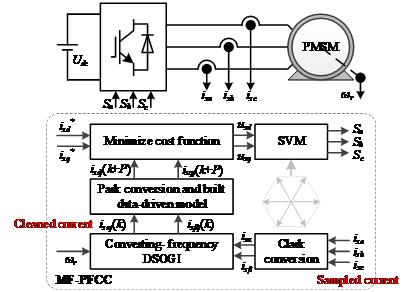
Illustration of the Research(Image by Prof. WANG’s group)
Contact:
Prof. WANG Fengxiang
Fujian Institute of Research on the Structure of Matter
 Chinese Academy of Sciences
Email: fengxiang.wang@fjirsm.ac.cn
