Chiral optical materials have attracted strong attention in multiple disciplines due to their wide application value in various fields such as remote sensing, 3D display, information communication, and optical information storage. With the strong demand for stable and environmentally friendly materials, two-dimensional chiral lead-free halide double perovskites are expected to generate rich chiroptical and optoelectronic properties.
However, the reported chiral lead-free double perovskites are rare. The main challenge is that there is only one kind of organic cation A in the interlayer of double perovskites A4BIBIIIX8 (A is organic cation, BI and BIII are metallic cations, X is halogen.) and the selective domain of chiral cations A in double perovskites is limited by the width organic interlayer.
In a study published in Chem, the research group led by Prof. LUO Junhua from Fujian Institute of Research on the Structure of Matter of the Chinese Academy of Sciences proposed achiral-chiral cation intercalation strategy to rationally design a series of new enantiomeric lead-free halide double perovskites with asymmetric and chiral bifunctional features.
Through an unprecedented strategy of achiral-chiral cation intercalation, the researchers realized charge conservation and overall steric hindrance balance. The arrangement of the original intercalated cations is changed from a single cations A to diverse cations A+A¢, wherein A' represents abundant achiral cations.
The researchers synthesized a series of six new enantiomeric lead-free halide double perovskites (R/S-PPA)2(BA)2AgBiBr8, (R/S-PPA)2(BrPA)2AgBiBr8 and (R/S-PPA)2(Br-EA)2AgBiBr8, demonstrating the feasibility of this synthesis strategy.
Single crystal X-ray diffraction analysis showed that achiral and chiral cations arrange alternately and connect with diverse noncovalent intermolecular interactions like CH---π, π---π, CH---Br. These interactions make the chiral organic cations and achiral organic cations coexist stably and harmoniously in chiral halide double perovskites.
Further analysis showed that chiral compounds may prefer to possess more distorted structure because of their natural asymmetric features. Larger structural distortions generally result in lower crystal symmetries, inducing to asymmetry breaking and thus paving the way to the generation of circular dichroism (CD) and second harmonic generation (SHG) signals.
Taking compounds (R/S-PPA)2(Br-EA)2AgBiBr8 as examples, the researchers found that they present strong nonlinear optical response up to 2 times that of state-of-the-art KH2PO4 nonlinear crystals and robust circular dichroism signals in the visable region.
This study provides a new approach to explore chiral lead-free halide double perovskites.
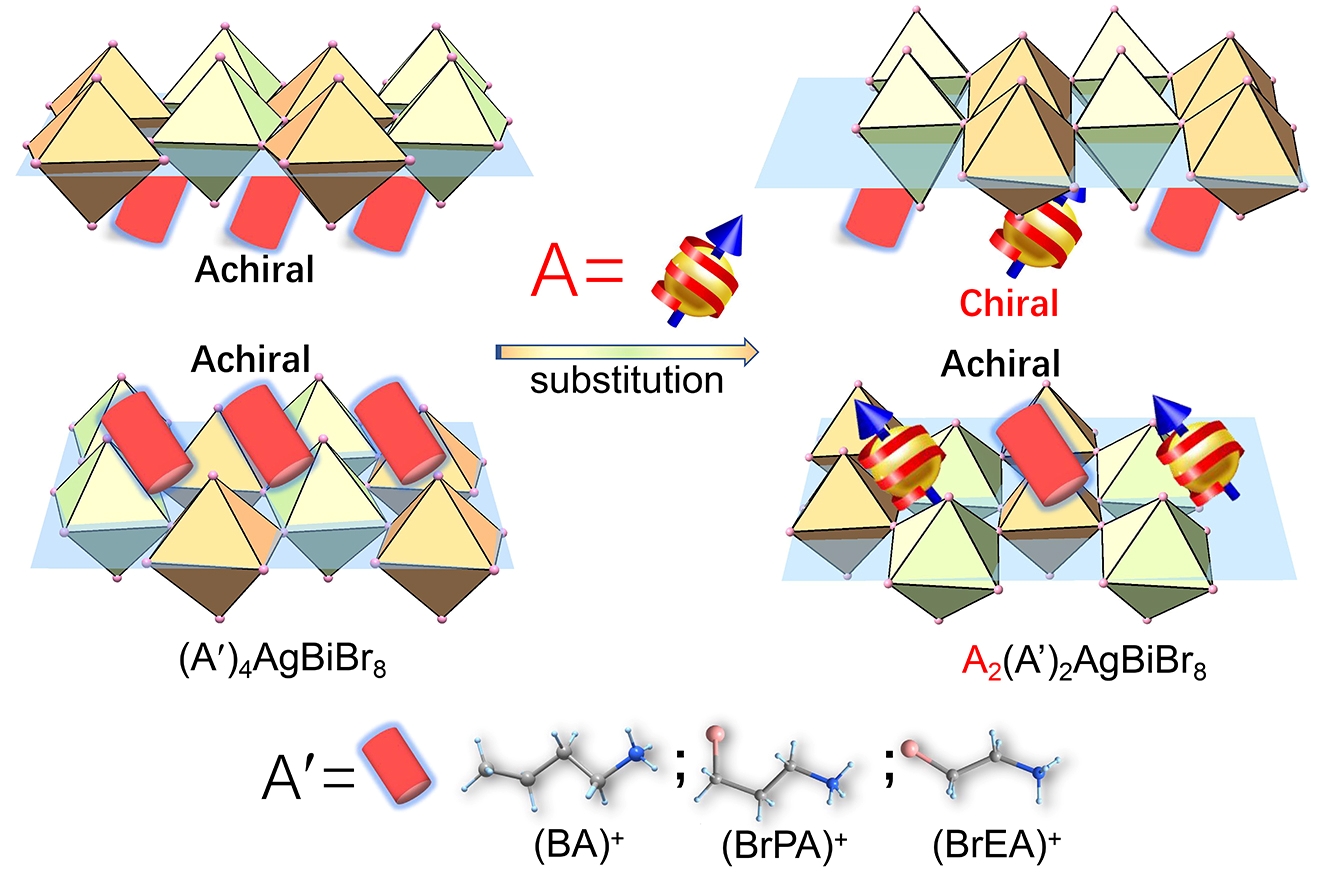
Schematic diagram of chiral-achiral cations intercalation strategy for designing a series of chiral lead-free halide double perovskites (Image by Prof. LUO’s group)
Contact:
Prof. LUO Junhua
Fujian Institute of Research on the Structure of Matter
Chinese Academy of Sciences
Email: jhluo@fjirsm.ac.cn
