In recent years, there has been a notable surge in the sales of electric vehicles across various nations, primarily attributed to the superior energy density and minimal self-discharge properties of lithium-ion batteries. However, the end of life of these electric vehicle batteries presents a significant challenge regarding their safe and efficient recycling and disposal. It is imperative to manage the decommissioning process by employing advanced and comprehensive facilities, which is crucial to mitigate the risk of environmental contamination.
In a study published in IEEE Transactions on Industrial Electronics, Dr. LIN Mingqiang's group from Fujian Institute of Research on the Structure of Matter of the Chinese Academy of Sciences introduced a pioneering data-driven transfer-stacking-based method for estimating the state of health (SOH) of lithium-ion batteries, a critical component for the safety and reliability of electric vehicles.
The researchers extracted features from the incremental capacity (IC) curve and constant current (CC) charging sub-process to depict the details of the battery aging pattern. Through mathematical calculation and geometric observation, 17 features are extracted from these sources. These features cover both the IC curve and CC charging phase, which are convenient to obtain and potentially relevant to the rated capacity used to define the SOH in this research.
A screening method has been applied to reduce the dimensionality of the extracted potential features since it can obtain the extracted features' importance and proceed with feature selection to achieve feature dimension reduction. Key steps include pruning less relevant features and employing a decision tree methodology to identify the most impactful features. This rigorous screening process is vital for building an efficient and accurate SOH estimation model, highlighting the importance of feature selection in data-driven battery health assessment.
Besides, the researchers utilized the transfer-stacking (TS) method for the SOH estimation of lithium-ion batteries. This method integrates multiple source models, established using support vector regression (SVR), to form a stacked model. Each source model is weighted and optimized using a portion of the target battery data. The TS approach effectively combines the strengths of individual models, enhancing the generalizability and accuracy of SOH estimation. This method demonstrates improved performance over traditional models, particularly in its ability to accurately estimate SOH with limited target battery data, thereby reducing the need for extensive aging data and ensuring more precise battery health assessments.
The TS method has been validated under different battery datasets by creating several experimental groups, each employing the TS-SVR model with specific battery combinations to estimate a target battery's SOH. The method involved training the model with the initial 30% of the target battery's aging data and testing it with the remaining data. This approach was benchmarked against traditional methods like Gaussian process regression (GPR), robust linear regression (RLR), and SVR.
Moreover, the researchers tested the robustness and generalizability of the TS-SVR method by applying the method to another Center for Advanced Life Cycle Engineering (CALCE) dataset. They established groups to estimate the SOH of various batteries, comparing the TS-SVR method's performance against the same benchmark algorithms. The results consistently showed that the TS-SVR method outperformed the others, demonstrating the lowest root mean square error and yielding more accurate and stable estimations.
This study presents innovative approaches in SOH estimation for lithium-ion batteries, showcasing the effectiveness of the TS-SVR method and emphasizing a shift from traditional techniques to more accurate, data-driven models.
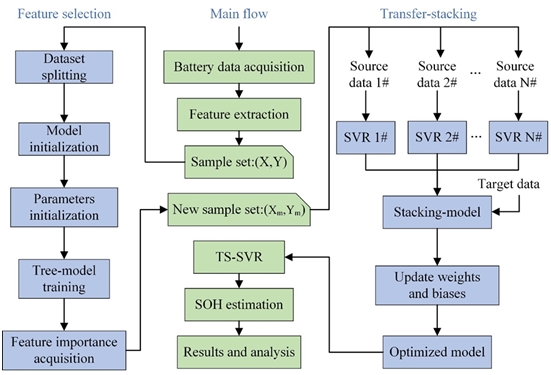
The procedure of the proposed SOH estimation method(Image by Dr. LIN’s group)
Contact:
Dr. LIN Mingqiang
Fujian Institute of Research on the Structure of Matter
Chinese Academy of Sciences.
E-mail: kdlmq@fjirsm.ac.cn
