Biomolecules-based materials hold great promisefor malignant tumor phototherapy. However, current supramolecular biomaterials primarily suffer from poor tissue penetration, inadequate tumor accumulation, and particularly neglecting the unique benefits of chirality, thus significantly limiting their phototherapeutic efficacy. Hitherto, designing near-infrared circularly polarized (NIR-CP) light-responsive supramolecular biomaterials with superior NIR chiroptical properties and enhanced phototherapeutic performance remains a challenge.
In a study published in Nano Today, a research group led by Prof. CHEN Xueyuan from Fujian Institute of Research on the Structure of Matter (FJIRSM) of Chinese Academy of Sciences (CAS) developed a novel NIR-CP light-responsive hybrid CuInSe2@ZnS quantum dots (CISe@ZnS QDs) hydrogel (QDs@L/D-Gel) for achieving distinctly enhanced therapeutic efficacy in vitro and in vivo upon exposure to 808-nm CP light.
Researchers fabricated the QDs@L/D-Gel by utilizing the self-assembly between CISe@ZnS QDs and amino acid precursors. The obtained QDs@L/D-Gel showcased distinctive NIR chiroptical activity (|gabs| up to 1.3 × 10⁻² and |glum| up to 3.4 × 10⁻³), prominently improved photothermal conversion efficiency (PCE) of 43%, and elevated reactive oxygen species (ROS) production upon exposure to 808-nm CP light.
Particularly, benefiting from NIR-CP light improved phototherapeutic efficacy, highly enhanced tumor retention (> 72 h),and superior biocompatibility, researchers observed a remarkably enhanced phototherapeutic efficacy (tumor inhibition rate = 83%) for QDs@L-Gel treated mice after NIR-CP light treatment without causing any toxic side effects, outperforming the identical material exposed to linearly polarized (LP) light directly emitted from an 808-nm laser device.
This study provides an innovative viewpoint on the utilization of NIR-CP light for achieving more rational and effective phototherapy, thereby potentially accelerating the exploitation and clinical translation of biomolecules-based materials for versatile biomedical applications.
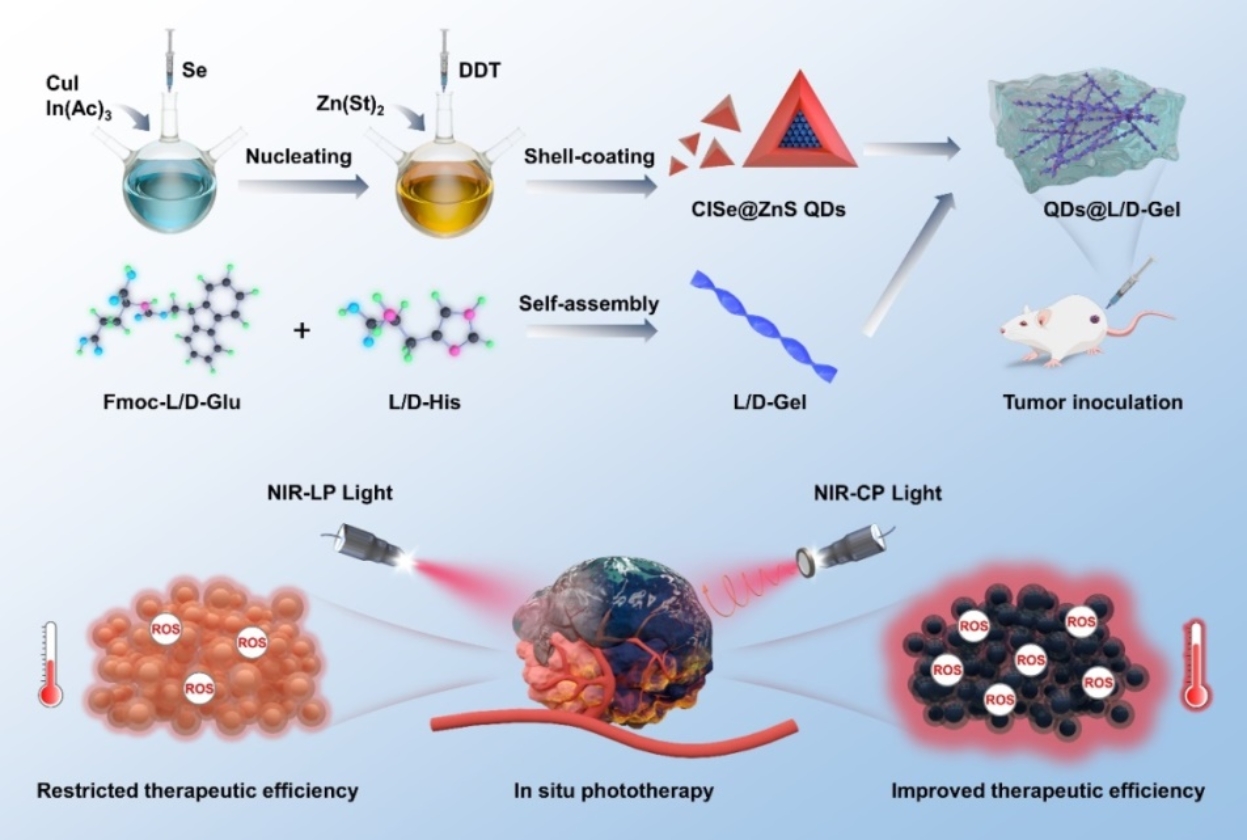
Schematic illustration for the preparation of QDs@L/D-Gel as NIR-CP light-responsive photothermal/photodynamic biomaterial for achieving improved phototherapeutic efficacy against malignant tumor. (Image by Prof. CHEN’s Group)
Contact:
Prof. CHEN Xueyuan
Fujian Institute of Research on the Structure of Matter
Chinese Academy of Sciences
Email: xchen@fjirsm.ac.cn
