Thermoelectric materials play a critical role in energy harvesting and thermal management, yet achieving ultralow lattice thermal conductivity (κlat)—a key factor for boosting their efficiency—remains a major challenge.
In a study published in Science Advances, a team led by Prof. Min Luo from the Fujian Institute of Research on the Structure of Matter, Chinese Academy of Sciences, proposed an innovative “forced bond ionization” strategy to address this issue, successfully synthesizing Cu₅TeS₃I₃ (CTSI)—a dense inorganic polycrystal with a record-low κlat of 0.17 W/(m·K) and notable flexibility, opening new avenues for flexible thermoelectric applications.
Traditional methods to lower κlat, such as electronegativity modulation, often come with trade-offs; some even rely on toxic or reactive elements like thallium (Tl) or cesium (Cs), limiting practical use. To avoid these pitfalls, the team leveraged conflicting coordination environments to induce “forced bond ionization”—a process that drives mixed covalent-ionic bonds toward partial ionization through structural design, rather than relying solely on electronegativity adjustments. CTSI features a chiral layered structure where copper (Cu) atoms face competing coordination demands: tetrahedral (four-coordination) and planar triangular (three-coordination). This arrangement forms pseudo-tetrahedral CuS₂I₂ units, leading to disordered Cu atom distribution and partial ionization of Cu-I bonds, fundamentally reshaping the material’s phonon transport behavior without harmful elements.
This unique structural design enables CTSI to exhibit a series of breakthrough properties: it maintains a κlat of 0.17 W/(m·K) across 300 K to 573 K, the lowest value ever reported for dense inorganic polycrystals, outperforming conventional sulfides and selenides. The pseudo-tetrahedral structure also reduces the transverse speed of sound to 839 m/s and enhances anharmonicity (Grüneisen parameter γ = 2.76), while disordered Cu atoms and ionized iodine (I) atoms strongly scatter phonons—limiting phonon mean free paths to the Ioffe-Regel limit and creating “glass-like” thermal conductivity. Unlike most rigid inorganic thermoelectrics, CTSI single-crystal sheets also show significant flexibility, thanks to weak interlayer interactions (electrostatic forces and van der Waals forces) and no overly rigid bonding within layers.
This study establishes a novel bond ionization-driven framework for developing ultralow κlat materials, breaking away from traditional strategies like atomic rattling or alloying. While CTSI’s electrical transport properties need further optimization (intense phonon scattering limits carrier relaxation time), its ultralow κlat and flexibility make it a promising candidate for eco-friendly, flexible thermoelectrics.
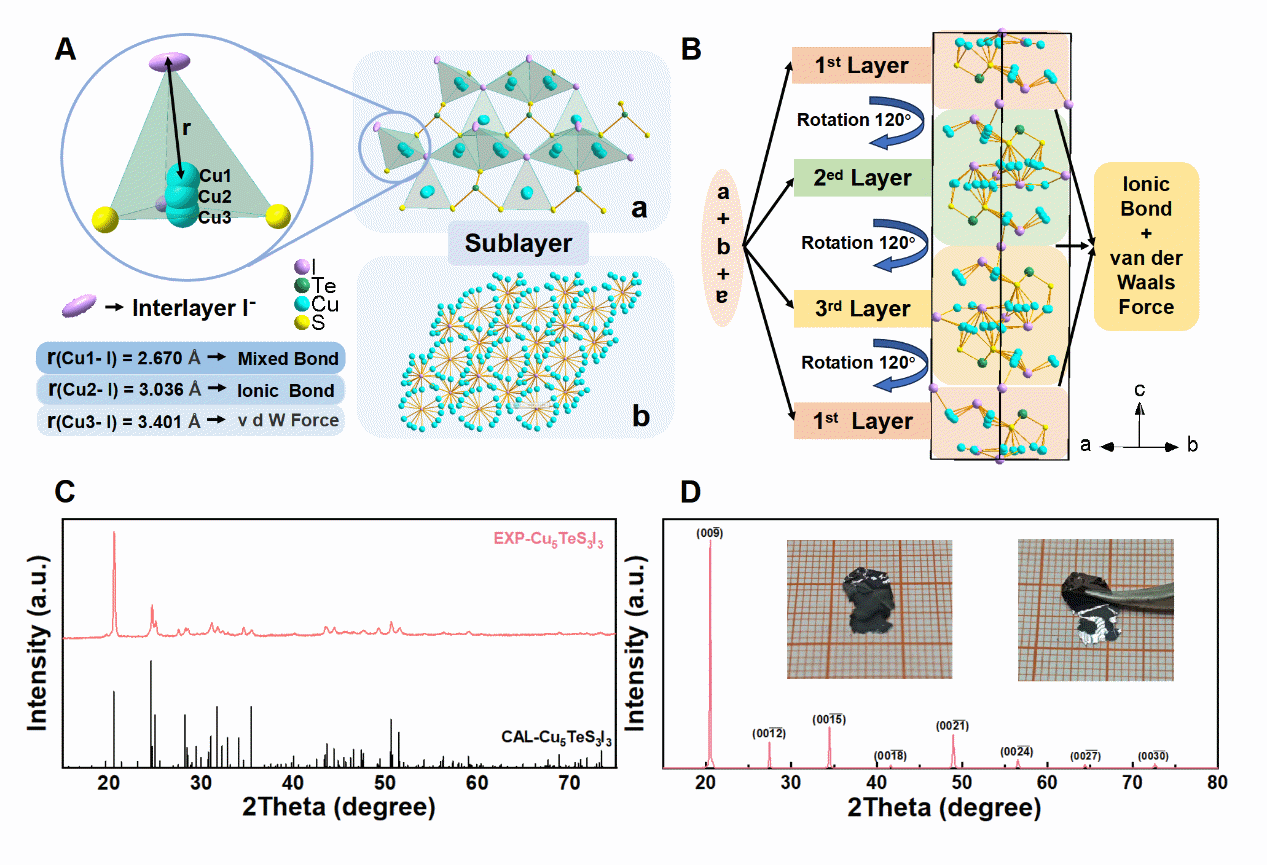
Crystal structure and the photos of flexible single crystal sheets (Image by Prof. LUO’s group)
Contact:
Prof. LUO Min
Fujian Institute of Research on the Structure of Matter
Chinese Academy of Sciences
Email: lm8901@fjirsm.ac.cn
