Low-dimensional materials are pivotal for next-generation electronics and energy conversion technologies due to their unique quantum confinement effects and exceptional electronic properties. However, reliably determining the effective dimensionality of the electronic band structure in these materials remains a significant challenge. Traditional methods, such as Angle-Resolved Photoemission Spectroscopy (ARPES) and Scanning Tunneling Microscopy (STM), often require ultra-clean surfaces and expensive ultra-high vacuum equipment, restricting their use for widespread, routine analysis.
To address this bottleneck, a research team led by Prof. LIN Yue from the Fujian Institute of Research on the Structure of Matter (FJIRSM), Chinese Academy of Sciences (CAS), in collaboration with Prof. G. Jeffrey Snyder from Northwestern University, developed a generalized transport model. This model serves as a simple, accessible method to measure dimensionality without relying on complex scattering assumptions. This study, titled "Dimensional Transport Crossovers in Thermoelectrics Revealed by a Simple Transport Model", was published in Nature Communications.
The researchers introduced a strategy that functions as an internal "dimensionality meter". By simply tracking how the Seebeck coefficient (S) varies with carrier concentration (n) or temperature (T), the specific electronic dimensionality (D) of a material can be rapidly and accurately deduced. This approach allows for the distinction between 1D, 2D, and 3D transport behaviors using standard experimental conditions.
Applying this approach to heavily doped Strontium Titanate (SrTiO3), the team revealed a doping-induced crossover. Once the carrier density surpasses 1×1020 cm-3, the transport behavior transitions from 3D to 2D-like, consistent with theoretical predictions of orbital-selective hybridization. In the layered material Bismuth Oxyselenide (Bi2O2Se), the study uncovered a temperature-triggered evolution. The material exhibits 1D transport at 60 K, shifts to 2D at 100 K, and evolves to 3D at 300 K, highlighting how phonon-assisted transport activates transverse conduction with increasing temperature.
Most notably, the researchers investigated the topological phase transition in Pb1-xSnₓTe alloys. They observed a striking deviation from ordinary 3D transport toward a 1D-like regime ( ) near the critical composition (x≈0.6). This behavior is attributed to the emergence of topologically protected conducting channels—such as hinge or interface states—that form percolating networks acting as quasi-1D conductors embedded within the 3D bulk. This finding suggests that topology can intrinsically alter the dimensionality of charge transport.
Crucially, because this generalized model is independent of scattering mechanisms, it provides a powerful preliminary diagnostic tool for organic polymer semiconductors, which are typically highly sensitive to microstructure and disorder. Furthermore, the framework can be directly applied to existing data in published literature or open databases, enabling high-throughput screening for low-dimensional electronic features.
This study offers a rapid, scattering-independent framework to design quantum and thermoelectric properties. By establishing a direct link between macroscopic transport signatures and low-dimensional electronic structures, the model accelerates the screening and design of materials with tailor-made electronic properties.
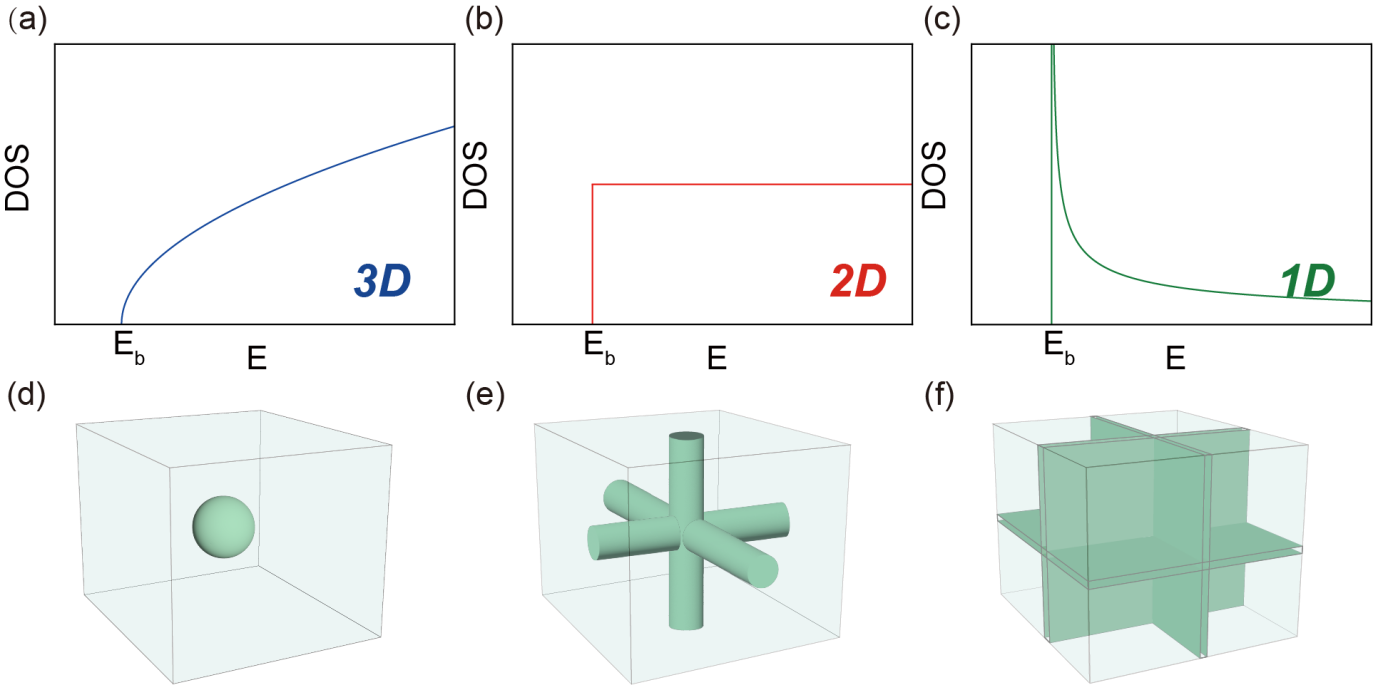
Schematic of the electronic density of states (top row) and corresponding Fermi surfaces (bottom row) for different dimensional systems.(Image by Prof. LIN’s group)
Contact:
Prof. LIN Yue
Fujian Institute of Research on the Structure of Matter
Chinese Academy of Sciences
Email: linyue@fjirsm.ac.cn
