Second-order nonlinear optical (NLO) crystals are essential for frequency conversion, allowing laser output to be shifted into otherwise hard-to-reach wavelength bands. These capabilities underpin applications ranging from atmospheric detection to secure communication. However, commercially available infrared NLO crystals often struggle to simultaneously deliver strong second-harmonic generation (SHG), high laser-induced damage threshold (LIDT), and sufficient birefringence to satisfy PM requirements.
In a study published in Angewandte Chemie International Edition, Prof. GUO Guocong and Prof. LIU Binwen from the State Key Laboratory of Structural Chemistry at the Fujian Institute of Research on the Structure of Matter (Chinese Academy of Sciences) has reported a practical route to achieving phase-matching (PM) in infrared NLO materials by deliberately amplifying birefringence through anisotropic lattice distortion.
The researchers synthesized a family of salt-inclusion chalcogenides, [ABa3Br2][Ga5Se10] (A = Cs 1, Rb 2, K 3, Na 4), and demonstrated that substituting Cl with Br in this structural motif induces a pronounced directional lattice distortion, thereby enhancing optical anisotropy and enabling PM capability.
According to the study, the Br-containing compounds crystallize in a tetragonal system and exhibit a smaller c/a ratio than their Cl-analogues, a signature of anisotropic lattice distortion. This distortion drives a measurable divergence between refractive indices along the a and c axes, consistent with axis-dependent redistribution of electron density. The result is a substantial boost in birefringence: 0.044–0.066 at 546 nm across compounds 1–4, enabling a transition from non-phase-matching (Cl-analogues) to phase-matching (Br compounds) at relevant operating wavelengths.
In powder SHG measurements at 1910 nm, the Br-based materials exhibit SHG signals of 1.04~1.58 times that of the benchmark infrared material AgGaS2, while maintaining band gaps greater than 3.0 eV—a combination that supports both frequency conversion performance and reduced absorption risk under high-power irradiation.
Importantly, the researchers also reports LIDT values of 17.5~19.5 MW·cm-2, corresponding to roughly 4.30~4.88 times that of AgGaS2, highlighting the robustness of these crystals under intense laser conditions.
Mechanistically, the authors attribute the PM-enabling birefringence to the directional nature of the lattice distortion: by strengthening anisotropy (rather than simply increasing overall polarizability), the materials achieve the refractive-index separation needed for PM without sacrificing stability-related metrics.
Beyond introducing a promising set of PM-capable selenide-based NLO candidates, the study offers a clear design principle: engineer large, axis-specific lattice distortions to enhance birefringence and unlock PM, particularly in salt-inclusion chalcogenide frameworks. This strategy may broaden the pipeline of practical infrared NLO crystals for tunable laser sources and other photonics technologies.
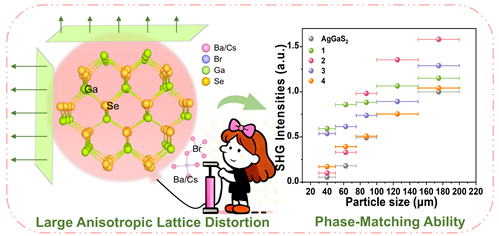
Illustration on the structural design of [ABa3Br2][Ga5Se10] (A = Cs, Rb, K, Na) and its NLO properties. (Image by Prof. GUO’s group)
Contact:
Prof. GUO Guocong
Fujian Institute of Research on the Structure of Matter
Chinese Academy of Sciences
Email: gcguo@fjirsm.ac.cn
