Deep-ultraviolet nonlinear optical (DUV NLO) crystals are critical functional materials for advanced technologies, including high-resolution photolithography, precision laser processing, environmental monitoring, and biomedical diagnostics. However, achieving an exceptional DUV NLO crystal requires the simultaneous optimization of three key properties: a short ultraviolet cutoff edge, strong second-harmonic generation (SHG) response, and appropriate birefringence. These properties are often interdependent and mutually constraining. In particular, within sulfate-based systems, the tetrahedral [SO₄]²⁻ unit, while favorable for a wide bandgap and deep-ultraviolet transparency, typically exhibits high symmetry that limits polarizability anisotropy and second-order hyperpolarizability, thereby restricting both SHG response and birefringence.
In a recent study published in Angew. Chem. Int. Ed, Prof. LUO Min’s group at the Fujian Institute of Research on the Structure of Matter, Chinese Academy of Sciences, proposed a “confined π-conjugation” strategy. By incorporating a flexible, confined π-conjugated fragment into the sulfate framework, they successfully designed and synthesized a novel DUV NLO sulfonate crystal, Li[OOCCH(NH₃)CH₂SO₃] (LCNS).
This work builds on the approach of rationally designing non-centrosymmetric (NCS) crystals through structural module pre-design, as exemplified in previous hydrogen-bond-directed modular assembly strategies. The key difference here is the use of confined π-conjugated groups to simultaneously optimize bandgap, birefringence, and SHG response. the limitations of conventional sulfate materials, the researchers introduced a “three-birds-with-one-stone” design concept. Specifically, the [–COO] segment significantly enhances the polarizability anisotropy and hyperpolarizability of the anionic group, while the [–CH₂CH(NH₃)–] fragment restricts excessive π-electron delocalization, maintaining a large HOMO–LUMO gap. Furthermore, the inclusion of [–NH₃]⁺ facilitates the formation of a chiral NCS structure, increasing the likelihood of crystallization in non-centrosymmetric space groups. Consequently, the resulting anionic unit, [OOCCH(NH₃)CH₂SO₃]⁻, combines strong optical activity with deep-ultraviolet transparency.
Guided by this design strategy, the team obtained high-quality, colorless LCNS single crystals via an aqueous solution method. Structural analysis revealed that LCNS crystallizes in the chiral NCS space group P2₁. The crystal structure comprises the flexible confined π-conjugated segment [OOCCH(NH₃)CH₂–], the non-π-conjugated sulfonate portion [SO₃X], and [LiO₄] coordination units forming a three-dimensional framework. Li⁺ ions coordinate with the terminal oxygens of the carboxylate groups, effectively reducing dangling bonds and nonbonding electron effects, which helps maintain a wide bandgap. Simultaneously, the relative coplanar arrangement of the carboxylate groups provides a structural basis for enhanced birefringence and SHG response.Performance evaluation demonstrates that LCNS exhibits outstanding comprehensive DUV NLO properties. The compound shows a short ultraviolet cutoff edge of 177 nm, a record SHG response of 4.5 × KDP, and exceptional birefringence (Δn = 0.090 at 589 nm) among DUV NLO sulfonates.
This study not only provides a promising candidate for DUV NLO applications but also validates the efficacy of the “confined π-conjugation modification of non-π-conjugated groups” as a rational structural design strategy. Analogous to the hydrogen-bond-directed modular assembly approach described in previous work, this study exemplifies a design paradigm in which functional building units are leveraged, and structural orientation is controlled to achieve non-centrosymmetric crystals with superior optical properties, offering important guidance for the rational design of next-generation high-performance ultraviolet and deep-ultraviolet NLO crystals.
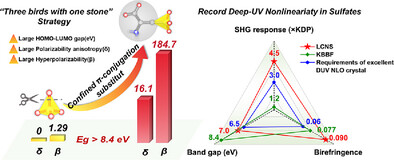
Illustration of the Research (Image by Prof. LUO’s group)
Contact:
Prof. LUO Min
Fujian Institute of Research on the Structure of Matter
Chinese Academy of Sciences
Email: lm8901@fjirsm.ac.cn
