N,N-dimethylformamide (DMF) is an indispensable solvent and reactive precursor in pharmaceuticals, textiles, and advanced manufacturing, with its global market projected to reach US$3.59 billion by 2030. Conventional thermochemical DMF production, however, suffers from high energy consumption and substantial environmental burden. Although electrochemical synthesis offers a mild alternative, it has long been plagued by low Faradaic efficiency (<50%), poor stability, and insufficient productivity for industrial applications.
In a study published in Nature Communications, Prof. ZHU Qilong's research group from Fujian Institute of Research on the Structure of Matter, Chinese Academy of Sciences, has developed a redox-mediated domino electrosynthesis strategy that converts a complex multistep reaction into an efficient and controllable pathway, achieving industrially relevant DMF production rates with over 90% Faradaic efficiency.
The researchers engineered a binder-free, single-molecule-integrated electrode (PyCoPc/GF) based on a pyrrolidone-functionalized cobalt phthalocyanine anchored onto graphite felt. Taking advantage of in situ electrogenerated molecular iodine (I2) as a redox mediator, the reaction pathway was reconfigured to favor the formation of a key iminium cation intermediate, thereby initiating a highly efficient domino reaction sequence from methanol to DMF with high C–N coupling selectivity.
In an H-type electrolytic cell, the PyCoPc/GF electrode operated stably for over 150 h at 50mA cm–2, delivering a Faradaic efficiency (FEDMF) exceeding 90% and a DMF productivity of 839μmol h–1 cm–2. When deployed in a flow cell under industrially relevant conditions (–200mA cm–2), the system achieved an anodic DMF productivity as high as 2.75 mmol h–1 cm–2. Remarkably, the cathodic compartment simultaneously converted electrochemically generated CO2-derived CO into high-value amide compounds (e.g., an AMPA receptor modulator analogue) via aminocarbonylation, demonstrating a powerful paired-electrosynthesis platform.
Furthermore, through in situ spectroscopic analysis and density functional theory calculations, the team elucidated the iodine‑mediated domino mechanism. Molecular iodine acts as an electron‑transfer mediator that divides the original high-energy barrier (0.64eV) into two lower-energy steps (0.37eV and 0.28eV), facilitating the formation of the iminium cation intermediate and enabling the sequential “domino” transformation. This mediator-guided restructuring significantly improved the overall efficiency, raising the FEDMF from 16% (without mediator) to over 91%.
This study not only establishes a robust, scalable route for sustainable DMF electrosynthesis but also provides a new paradigm for redox-mediated domino reactions and paired electrolysis systems. The modular design and impressive performance metrics highlight its strong potential for industrial deployment in the production of high-value organic nitrogen compounds.
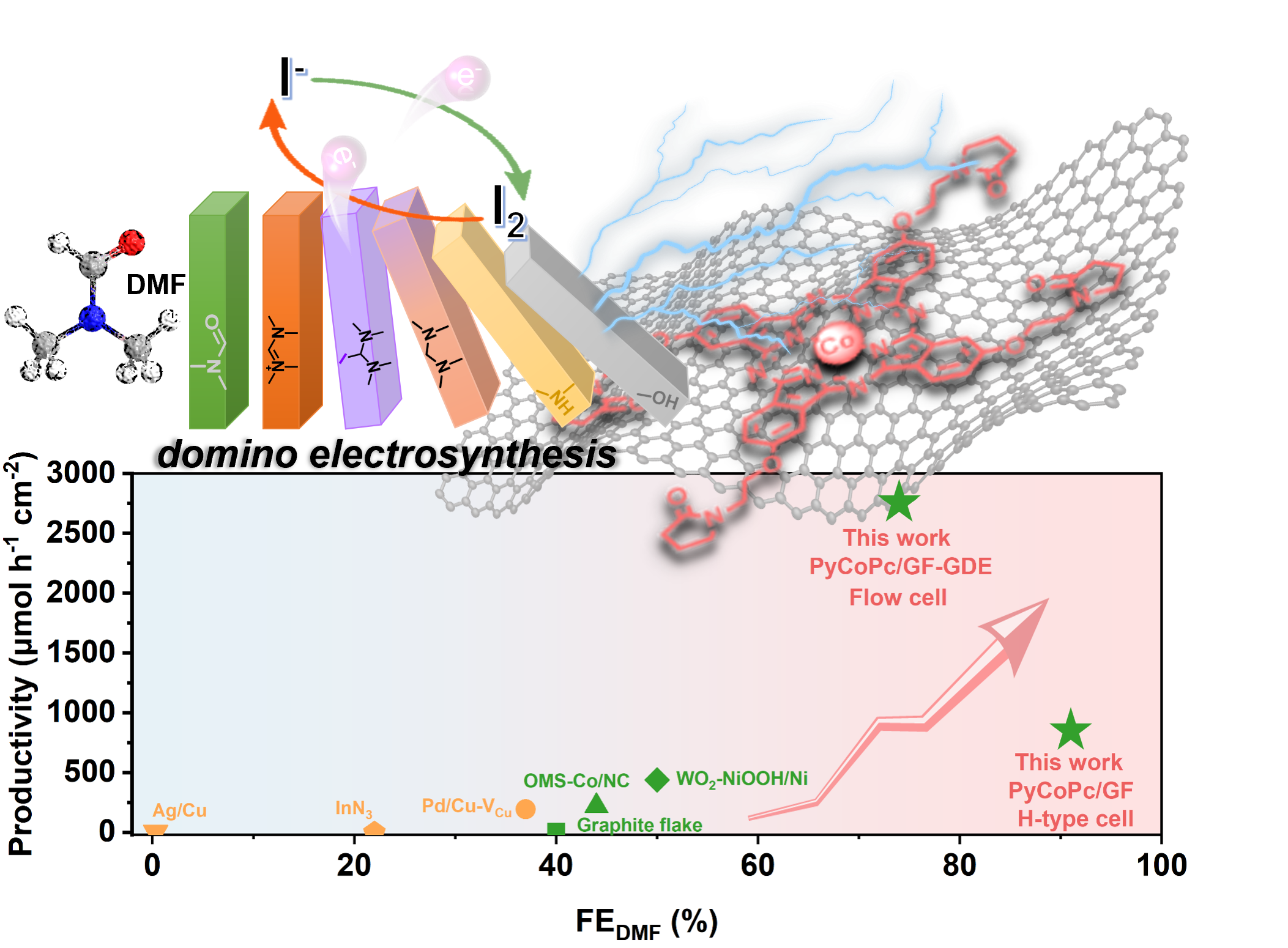
A redox-mediated domino electrosynthesis strategy enables industrial-relevant production of N,N-dimethylformamide using a single-molecule-integrated PyCoPc/GF electrode (Image by Prof. ZHU’s group)
Contact:
Prof. ZHU Qilong
Fujian Institute of Research on the Structure of Matter
Chinese Academy of Sciences
Email: qlzhu@fjirsm.ac.cn
