Hydrogen-bonded organic frameworks (HOFs) are a distinctive class of crystalline porous materials assembled from organic building blocks through intermolecular hydrogen bonding and other non‑covalent interactions. They have attracted considerable attention and demonstrated promising potential in diverse fields, including adsorption and separation, catalysis, sensing, and drug deliver. To date, the synthesis of most reported HOFs generally follows a multi-step sequence: (1) preparation of hydrogen‑bonding monomers from precursors via synthetic routes such as Suzuki coupling or nitrile‑dicyandiamide reactions, often requiring multiple steps along with complex separation and purification; (2) dissolution of the resulting monomers in a suitable solvent system; and (3) self-assembly crystallization of the building blocks through solvent evaporation or anti-solvent induction.
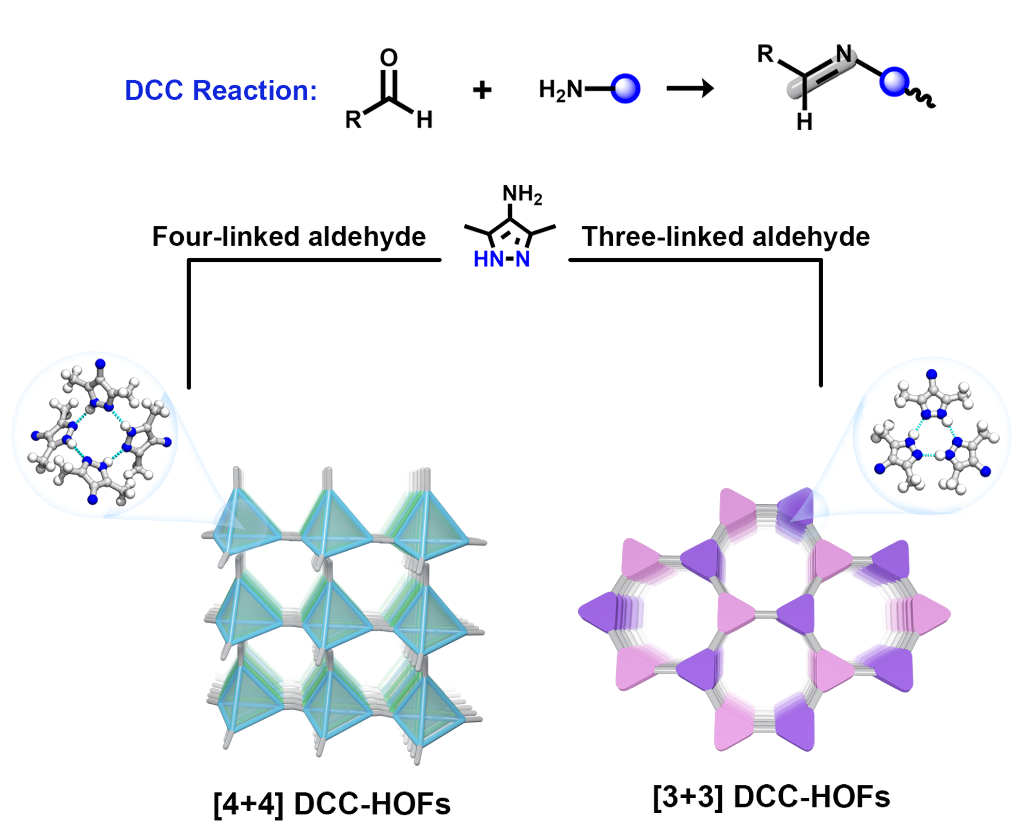
In a recent study published in Angew. Chem. Int. Ed., Professors YUAN Daqiang and SU Kongzhao, along with their colleagues at the Fujian Institute of Research on the Structure of Matter, Chinese Academy of Sciences, reported a dynamic covalent chemistry (DCC) strategy that enables the direct and efficient gram-scale synthesis of single-crystal HOFs, designated as DCC-HOFs.
Using a one-pot Schiff-base reaction between pyrazole amine and aromatic aldehyde precursors, they obtained two distinct families of HOFs. Four [3+3] 2D DCC-HOFs featuring one-dimensional hexagonal pores were constructed through N-H⋅⋅⋅N hydrogen‑bonded trimers, while two isoreticular [4+4] 3D DCC‑HOFs, exhibiting four‑fold interpenetrated diamond networks with one-dimensional square channels, were formed via N-H⋅⋅⋅N hydrogen‑bonded tetramers.
All six DCC‑HOFs were comprehensively characterized by single‑crystal X‑ray diffraction (SCXRD), NMR spectroscopy, ESI‑TOF‑MS, and gas sorption measurements. Notably, DCC‑HOF‑3 possesses a pore size of up to 1.86 nm, which is not only the largest reported among pyrazole‑based HOFs, but also exceeds that of most known HOFs. Owing to the exceptional structural stability of the highly porous [4+4] 3D DCC‑HOFs across a broad aqueous pH range (2~14), their potential as drug delivery carriers was evaluated using DCC‑HOF‑Si as a representative example.
This study presents the first systematic synthesis of HOFs via a straightforward and efficient DCC‑based approach and demonstrates their application in drug delivery. The study exemplifies a versatile strategy for constructing robust HOFs through dynamic covalent chemistry, highlighting the utility of reversible bond formation in the design of crystalline porous frameworks.
Schematic representation illustrating the IPOCs for NH₃ capture and sensing. (Image by Prof. YUAN’s group)
Contact:
Prof. YUAN Daqiang
Fujian Institute of Research on the Structure of Matter
Chinese Academy of Sciences
Email:ydq@fjirsm.ac.cn
