Ammonia (NH3) is an indispensable chemical feedstock for fertilizers, pharmaceuticals, and emerging carbon-neutral energy systems. However, the conventional Haber–Bosch process requires harsh operating conditions and is associated with high energy consumption and carbon dioxide emissions, driving the development of more sustainable ammonia synthesis technologies.
Electrochemical nitrate reduction reaction (NO3⁻RR) powered by renewable electricity provides an attractive route to simultaneously remove nitrate pollutants and produce value-added NH3. Nevertheless, the practical efficiency of NO3−RR is still restricted by sluggish multistep electron/proton transfer, competitive hydrogen evolution reaction (HER), and unclear dynamic interactions among active sites during catalysis.
In a study published in Proceedings of the National Academy of Sciences of the United States of America (PNAS), the research team led by Prof. HAN Lili from Fujian Institute of Research on the Structure of Matter (FJIRSM) of Chinese Academy of Sciences, reported an inside-out engineered CuOx@CNT/Ru catalyst for efficient electrochemical nitrate reduction to ammonia. The catalyst integrates amorphous copper oxide (CuOx) nanowires confined inside carbon nanotubes (CNTs) with ultrasmall ruthenium (Ru) nanoparticles anchored on the outer CNT surface, enabling strong CuOx–Ru electronic coupling while maintaining spatial separation.
The researchers synthesized CuOx@CNT/Ru through a combined chemical oxidation and thermal reduction strategy. In this inside-out architecture, amorphous CuOx nanowires are confined inside carbon nanotubes (CNTs), while ultrasmall Ru nanoparticles are anchored on the outer CNT surface. Microscopic and spectroscopic characterizations confirmed the spatially separated distribution of CuOx and Ru sites, as well as strong electronic interaction between them.
The optimized CuOx@CNT/Ru catalyst exhibited excellent NO3−RR performance in alkaline electrolyte. It achieved a high NH3 Faradaic efficiency of 99.1 ± 0.9% at 0 V reversible hydrogen electrode (RHE), an energy efficiency of 43.5 %, and a maximum NH3 yield rate of 146.37 mg h−1 mgcat−1 at −0.7 V. The catalyst also showed stable NH3 production over repeated cycling and long-term electrolysis, demonstrating its high activity and durability.
To clarify the catalytic mechanism, the team combined in-situ attenuated total reflectance surface-enhanced infrared absorption spectroscopy (ATR-SEIRAS), online differential electrochemical mass spectrometry (DEMS), in-situ X-ray absorption spectroscopy (XAS), quasi-in-situ electron paramagnetic resonance (EPR), and density functional theory (DFT) calculations. The results revealed that Ru sites serve as the main catalytic centers for nitrate adsorption and hydrogenation, while high-valence CuOx stabilizes and activates Ru sites, promotes the initial *NO3 to *NO2 conversion, and facilitates water dissociation to supply active hydrogen species.
Furthermore, CuOx@CNT/Ru was applied as the cathode in a Zn–NO3− battery, which delivered an open-circuit voltage of 1.64 V and a maximum power density of 22.6 mW cm−2. During a 12 h discharge test, the battery maintained a high NH3 Faradaic efficiency of 95.6%, demonstrating the potential of this catalyst for coupling nitrate removal, ammonia production, and electricity generation.
This study highlights an effective inside-out catalyst design strategy for regulating synergistic active-site interactions in electrochemical nitrogen conversion. By integrating confined CuOx nanowires and external Ru nanoparticles within a conductive CNT framework, the work provides new insights into stabilizing Ru-based catalysts, promoting nitrate activation, suppressing side reactions, and advancing sustainable ammonia electrosynthesis.
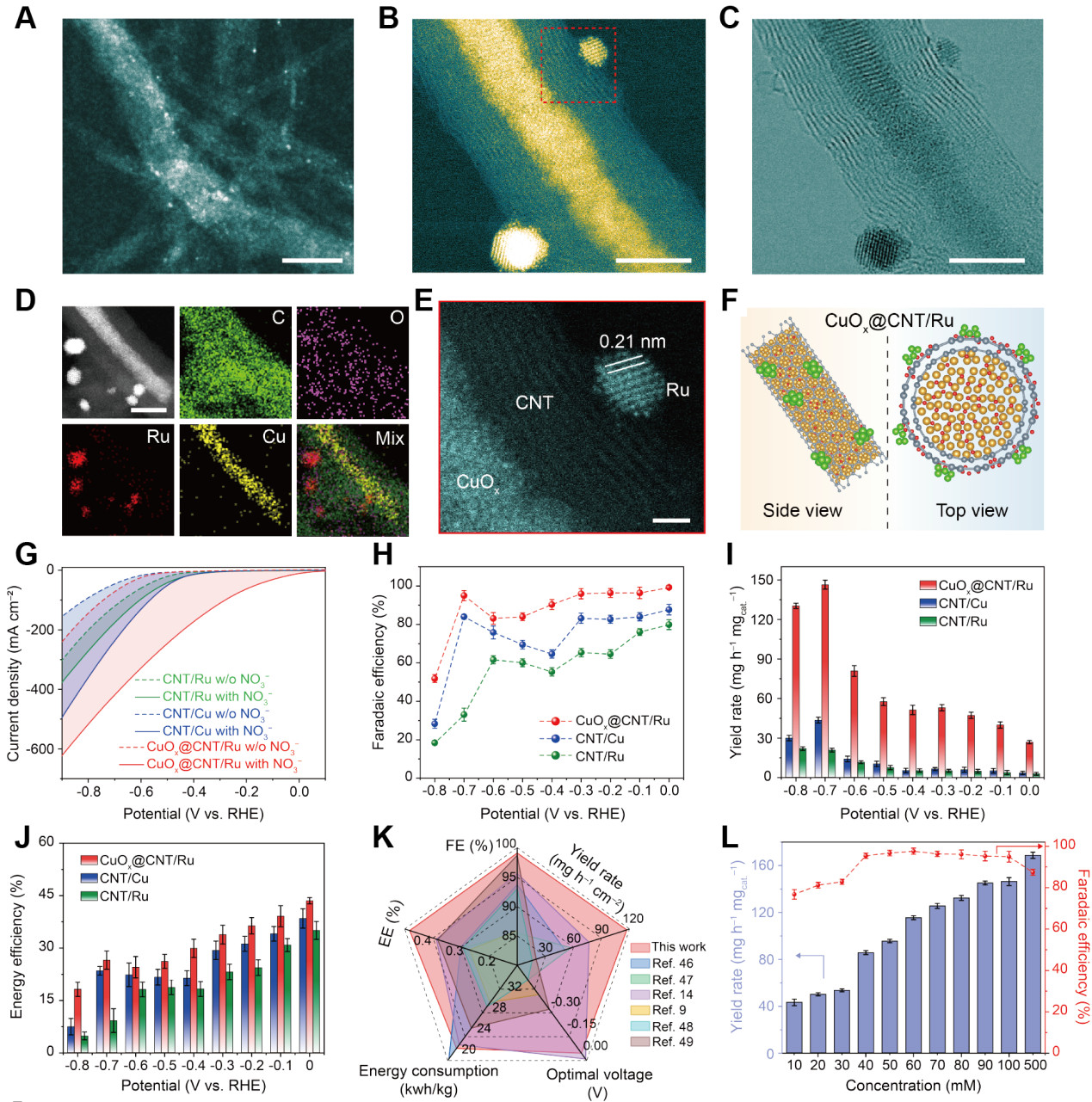
Structural characterization and nitrate-reduction performance of the inside-out CuOx@CNT/Ru architecture(Image by Prof. HAN's group)
Contact:
Prof. HAN LiLi
Fujian Institute of Research on the Structure of Matter
Chinese Academy of Sciences
Email: llhan@fjirsm.ac.cn
