Most planar organic fluorescent dyes are plagued by aggregation-caused quenching (ACQ) due to strong intermolecular π−π interactions, severely limiting their utility in practical applications.
In a study published in Chemistry – An Asian Journal, the research group led by Prof. GAO Peng from the Fujian Institute of Research on the Structure of Matter, Chinese Academy of Sciences, has proposed an innovative molecular design strategy based on cyclohexadienone spiro molecules with aggregation-induced emission (AIE) and unique dual-fluorescence performance.
The researchers adopted spiro-PT-OMeTAD as a model compound to explore the luminescence mechanism. Experimental verification confirms that the dual emission peaks originate from the locally excited (LE) and twisted intramolecular charge transfer (TICT) states, enabling stable, controllable dual fluorescence.
Structural analysis clarifies the key role of the cyclohexadienone spiro architecture. The electron-withdrawing carbonyl group in the molecular structure efficiently promotes charge separation and activates the TICT process for effective luminescence.
Meanwhile, the asymmetric spiro geometry provides strong steric hindrance, preventing close molecular stacking and fundamentally eliminating the ACQ effect. This ingenious structural design perfectly balances charge transfer luminescence and anti-quenching performance.
A series of derivatives, including spiro-PT-BA, spiro-PT-PA, and spiro-PT-MA, were synthesized to verify the universality of this mechanism. All derivatives exhibit similar stable dual-fluorescence characteristics, proving the strategy’s general applicability for developing high-performance fluorescent dyes.
Benefiting from its polarity-responsive optical properties, spiro-PT-BA was employed as a sensitive probe for trace water detection in tetrahydrofuran (THF) and as a visual temperature sensor.
This study provides a novel, universal approach to constructing AIE dual-fluorescence materials, offering promising prospects for environmental monitoring, chemical detection, and intelligent optical sensing devices.

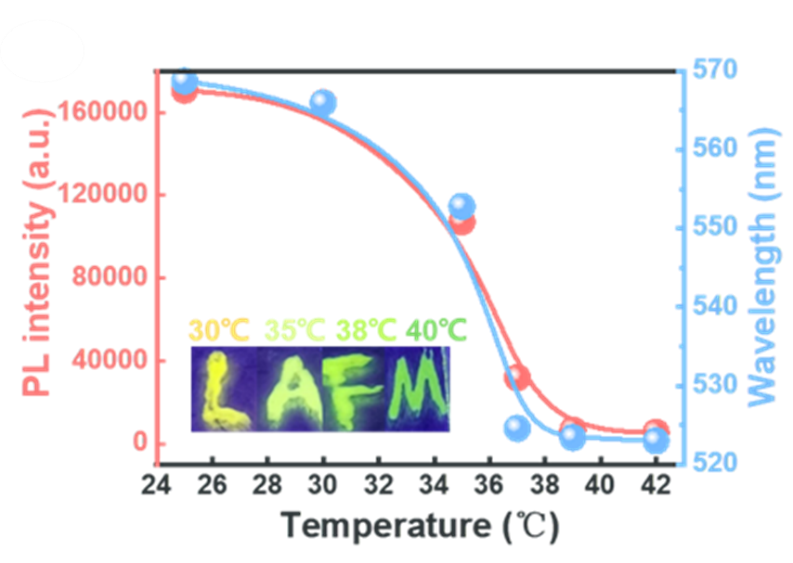
Temperature-sensing fluorescent probe based on spiro-PT-BA showing the colorful LOGO of LAFM(Image by Prof. GAO’s group)
Contact:
Prof. GAO Peng
Fujian Institute of Research on the Structure of Matter
Chinese Academy of Sciences
Email: peng.gao@fjirsm.ac.cn
