Hydrogen peroxide (H2O2) is a widely used green oxidant and an emerging liquid energy carrier for chemical manufacturing, environmental remediation and clean-energy technologies. At present, industrial H2O2 production still relies largely on the anthraquinone process, which requires energy-intensive operation and generates organic waste. Photocatalytic synthesis from water and oxygen offers a sustainable alternative, but it requires photocatalysts that can combine visible-light absorption, charge separation, active-site accessibility and long-term stability.
Hydrogen-bonded organic frameworks (HOFs) are crystalline porous materials assembled through reversible hydrogen bonds. Their mild synthesis, solution processability and high crystallinity make them attractive platforms for establishing structure-property relationships. However, HOFs have remained less explored for photocatalytic H2O2 production because many systems suffer from limited structural stability in water and insufficiently integrated photoactive units.
In a study published in Nature Communications, a research team led by Prof. FANG Yu developed a single-site oxidation-state engineering strategy to regulate both the topology and photocatalytic properties of phenothiazine-based HOFs. The work was reported in the paper titled “Single-site oxidation-directed topological evolution of hydrogen-bonded organic frameworks for efficient photocatalysis.”
The researchers introduced phenothiazine (PTH) as a photosensitive core and benzimidazole units as hydrogen-bonding motifs. By stepwise oxidation of the sulfur center in PTH, they constructed three crystalline HOFs, namely PTH-S-HOF, PTH-SO-HOF and PTH-SO2-HOF, through a one-pot in-situ assembly strategy. Single-crystal X-ray diffraction analysis showed that the oxidation state of the sulfur site reshapes the hydrogen-bonding network and directs the structural evolution from a (3,3)-connected net to more interconnected (6,3)-connected frameworks.
The sulfone-containing PTH-SO2-HOF displayed the most favorable photophysical properties among the series. Compared with PTH-S-HOF and PTH-SO-HOF, PTH-SO2-HOF showed lower photoluminescence intensity, a longer fluorescence lifetime, stronger transient photocurrent response and lower electrochemical impedance. Femtosecond transient absorption spectroscopy further revealed prolonged charge-carrier lifetimes for PTH-SO2-HOF, with the slow decay component reaching 1.29 ns, indicating suppressed charge recombination and improved charge transport.
These structural and electronic features translated into enhanced photocatalytic H2O2 production. Under visible light irradiation in pure water and an oxygen atmosphere, PTH-SO2-HOF achieved an H2O2 production rate of 2480 umol g-1 h-1 without any sacrificial agent. When methanol was used as a hole scavenger, the production rate increased to 5329 umol g-1 h-1. Control experiments with molecular monomers and reference frameworks confirmed that the ordered HOF architecture plays an essential role in improving catalytic performance.
The researchers also clarified the reaction pathway through scavenger experiments, electron paramagnetic resonance spectroscopy, nitroblue tetrazolium assays, rotating ring-disk electrode measurements, isotope-labeling experiments and in-situ diffuse reflectance infrared Fourier transform spectroscopy. The results indicate that H2O2 is generated mainly through a two-electron oxygen reduction reaction involving superoxide and hydroperoxyl intermediates, while a parallel water oxidation reaction produces oxygen that can feed back into the reduction pathway.
Density functional theory calculations further supported the proposed mechanism. The calculations suggested that sulfur oxidation promotes electron accumulation on the PTH core and improves spatial charge separation between the PTH unit and benzimidazole linker. In PTH-SO2-HOF, a large fraction of photogenerated electrons is localized on the PTH core, which is favorable for oxygen activation and H2O2 formation.
This study demonstrates that single-site oxidation can serve as a powerful molecular handle for controlling hydrogen-bonding topology, framework stability and charge-transfer behavior in HOFs. Beyond developing an efficient HOF photocatalyst for H2O2 production, the work provides a design blueprint for robust crystalline organic photocatalysts in sustainable chemical synthesis.
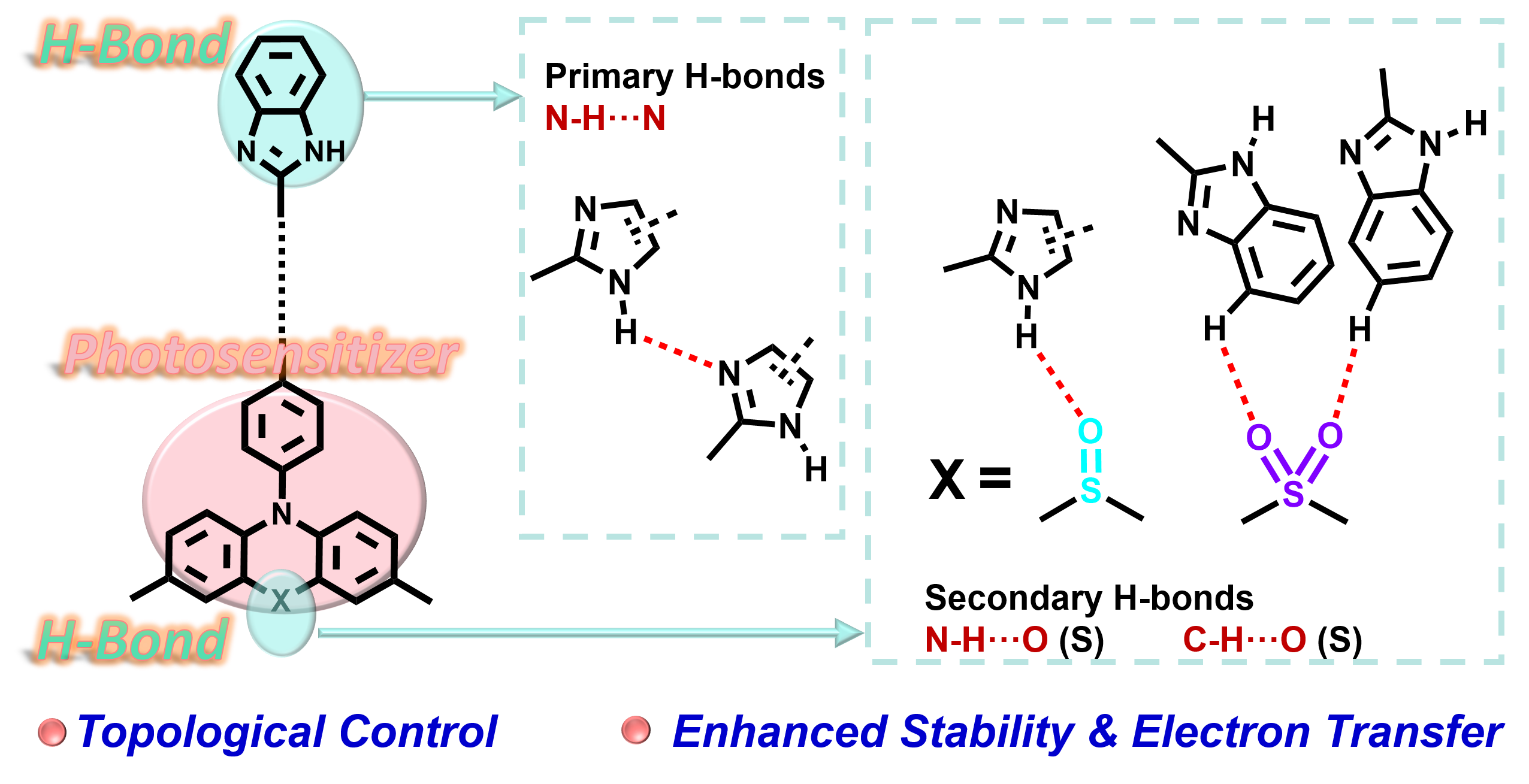
Single-site oxidation of the phenothiazine core modulates hydrogen-bonding interactions, enabling topological control, enhanced framework stability and improved electron transfer. (Image by Prof. FANG’s group)
Contact:
Prof. FANG Yu
Fujian Institute of Research on the Structure of Matter
Chinese Academy of Sciences
Email: yu.fang@fjirsm.ac.cn
