Rechargeable zinc-air/oxygen batteries (ZABs/ZOBs) are promising next-generation energy storage technologies due to their high energy density, low cost and environmental safety. However, their commercialization is hindered by the sluggish oxygen evolution reaction (OER) during charging, which causes low round-trip efficiency and poor cycling durability.
Replacing OER with the faster hydrogen peroxide oxidation reaction (HPOR) has emerged as a transformative solution. Yet this requires a bifunctional catalyst that achieves both near-perfect four-electron oxygen reduction reaction (ORR) selectivity during discharge and efficient HPOR activity during charging. Precisely modulating pyridinic nitrogen—the most active ORR sites—in nitrogen-doped carbon materials at the atomic level remains a major challenge.
In a study published in the Journal of Colloid and Interface Science, a team led by Prof. HUANG Junheng and Prof. WEN Zhenhai from Fujian Institute of Research on the Structure of Matter of Chinese Academy of Sciences and Fuzhou University has developed a novel "defect-guided in situ atomic substitution" strategy to address this issue. This work was published online on March 29, 2026, at https://doi.org/10.1016/j.jcis.2026.140412.
The researchers used highly fluorinated graphene as a self-sacrificial precursor to achieve synchronous defluorination, graphitization and precise nitrogen doping via a one-step thermochemical process. At 900℃ under nitrogen atmosphere, C–F bond cleavage generates transient carbon vacancies that anchor nitrogen species from urea pyrolysis, forming pyridinic nitrogen-doped graphene (PN-G) with a high density of active sites.
Multiscale characterizations confirmed the transformation from amorphous fluorinated graphene to a highly crystalline graphene network with uniform nitrogen distribution. XPS and synchrotron XANES analyses showed PN-G contains 58.6% pyridinic nitrogen and 41.4% graphitic nitrogen, with negligible inactive nitrogen oxides. The fully restored sp2-conjugated framework ensures excellent electrical conductivity.
PN-G exhibits exceptional bifunctional catalytic performance. For ORR, it achieves a half-wave potential of 0.86 V vs. RHE and an average electron transfer number of ~3.90, matching commercial Pt/C while showing better stability. For HPOR, its onset potential is over 0.5 V lower than that of OER, requiring only 0.837 V vs. RHE to reach 10 mA cm-2 in a gas diffusion electrode system.
The team constructed an H2O2-mediated zinc-oxygen battery using PN-G as the cathode catalyst. The battery delivers a peak power density of 710 mW cm-2, a record-high round-trip efficiency of ~96% at 5 mA cm-2, and stable operation for over 1800 hours. In situ Raman spectroscopy identified the superoxide intermediate (*O2-) as the central species
in both ORR and HPOR processes.
This study establishes a controllable synthetic route for high-performance metal-free carbon catalysts with precisely tailored active sites. The defect-guided strategy can be extended to other energy conversion applications.
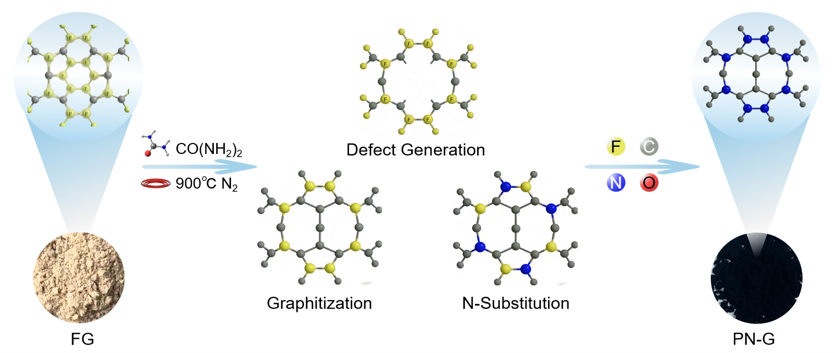
Schematic illustration of the defect-guided in situ atomic substitution strategy for synthesizing PN-G catalyst (Image by Prof. HUANG)
Contact:
Prof. HUANG Junheng
Fujian Institute of Research on the Structure of Matter
Chinese Academy of Sciences
Email: huangjunheng@fjirsm.ac.cn
