Excited-state intramolecular proton transfer (ESIPT) holds an important position in functional organic molecules, and it is essential to develop new structures and regulating mechanisms of ESIPT molecules. With a four-level photochemical process (E→E*→K*→K→E), hydrogen bond-mediated enol-to-keto tautomerization in the excited state leads to a large Stokes shift for the ketone emission and high sensitivity to surrounding environment.
In a recent study published in Nature Communications, Prof. YOU Lei along with his colleagues at the Fujian Institute of Research on the Structure of Matter, Chinese Academy of Sciences, reported the control of ESIPT luminogens via the manipulation of competing dynamic covalent bonds and hydrogen bonds.
The regulation of competing ring-chain equilibrium and dynamic covalent reactions with amines afforded unique hydrogen bonding patterns and luminogen-dependent ESIPT or intramolecular charge transfer (ICT) emission in solution.
Moreover, the nearby aldehyde engaged in intramolecular hydrogen bonding and allowed ICT emission in the solid state, and the higher energy excitation induced enamine emission, leading to excitation-wavelength-dependent performance.
Furthermore, mechanical grinding and acid fuming enabled structural conversion and cyclic hemiaminal/ketoimine dual emission, achieving switching of multistate emission colors. To show the utility, dynamic covalent reactions with amines/amino acids offered distinct hydrogen bonding patterns and facile color tuning in solid-state systems.
This study provides facile and diverse means for the regulation of functional molecules by the competing dynamic covalent and non-covalent interactions with multistate emission, enabling intelligent, stimuli-responsive systems for sensing, display, and adaptive materials.
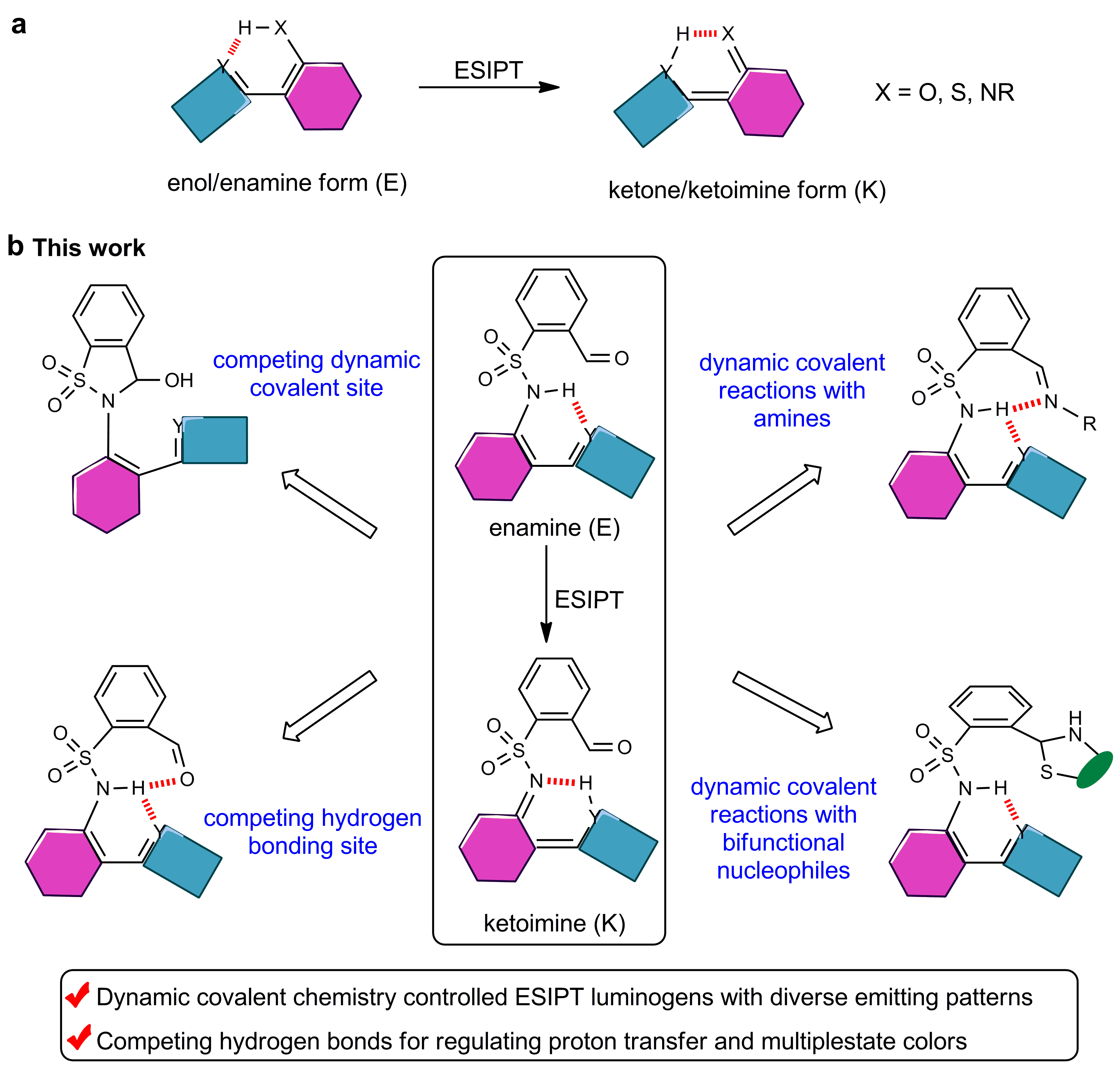
Excited-state intramolecular proton transfer luminogens regulated by competing dynamic covalent bonds and hydrogen bonds (Image by Prof. YOU Lei’s group)
Contact:
Prof. YOU Lei
Fujian Institute of Research on the Structure of Matter
Chinese Academy of Sciences
Email: lyou@fjirsm.ac.cn
