Hydrogen-bonded organic cages (HOCs) exhibit considerable potential in the fields of molecular recognition, catalysis, and separation due to their reversible, dynamic, and multifunctional structural features. However, rational design of giant HOCs composed of many components and possessing large cavities has remained a significant challenge, primarily constrained by the weak and directional nature of hydrogen-bond interactions.
In a study published in J. Am. Chem. Soc., Professors YUAN Daqiang and SU Kongzhao, along with their colleagues at the Fujian Institute of Research on the Structure of Matter, Chinese Academy of Sciences, proposed an assembly strategy synergizing covalent and hydrogen‑bond interactions, constructing an extra‑large hydrogen‑bonded snub cube (HSC), one of the 13 Archimedean solids, composed of 30 components, which demonstrated selective recognition and separation of fullerenes.
Researchers made significant progress in HOC research based on core building blocks such as calix[4]resorcinarene (C4RA). However, most structures are limited by the directionality and strength of hydrogen bonds, making it difficult to form giant architectures incorporating a larger number of components and larger cavities. For instance, the hexameric HOC reported by Atwood et al., consisting of six C4RA units, possesses a cavity volume of only 1492 ų. To overcome this bottleneck, the researchers exploited the dynamic covalent chemistry of a C4RA derivative combined with the triple-hydrogen-bond assembly capability of pyrazole molecules, devising a novel assembly strategy.
The researchers selected tetraformyl‑calix[4]resorcinarene (C4RACHO) and 3,5‑dimethyl‑1H‑pyrazol‑4‑amine (PyNH2) as building blocks. In a one-pot reaction, the phenolic hydroxyl groups of C4RACHO and pyrazole amine first form imine bonds, which subsequently undergo keto-enol tautomerization to yield thermodynamically more stable β‑ketoenamine (C-N) bonds, imparting rigidity and stability to the framework. Simultaneously, pyrazole units self‑assemble through intermolecular N-H···N hydrogen bonds to form trimers, which act as connecting nodes enclosing six C4RA units. Single-crystal X-ray diffraction confirmed the structure to be a hydrogen‑bonded snub cube, stabilized collectively by 24 intramolecular hydrogen bonds, 24 intramolecular hydrogen bonds, and 24 intermolecular hydrogen bonds, totaling 72 hydrogen bonds, making it one of the HOCs with the highest reported number of hydrogen bonds to date.
The HSC possesses an exceptionally large internal cavity with a volume of 5391 ų and an internal height of about 2.9 nm, far exceeding those of previously reported analogues. Diffusion-ordered spectroscopy (DOSY) NMR measurements yielded a hydrodynamic diameter of 3.7 nm, consistent with the crystallographic data. Owing to its enormous cavity, the HSC can simultaneously accommodate two fullerene molecules (C60 or C70), forming a rare 1:2 host-guest complex, whereas most known host molecules can only encapsulate a single fullerene.
Host-guest titration experiments and DFTB calculations revealed that the binding affinity of HSC for C70 is significantly higher than that for C60. This selectivity originates from tighter π···π interactions between C70 and the pyrazole units of the host (average distance 3.89 Å, compared to 4.07 Å for C60). Leveraging this property, the HSC can preferentially extract C70 from C60/C70 mixtures, demonstrating its potential application as a separation material for fullerenes.
This study overcomes the size limitations of traditional HOCs through a synergistic covalent- and hydrogen-bonding strategy, providing a novel approach for designing giant supramolecular cages with ultra-large cavities and specific recognition functions, while also offering a potential new type of adsorbent material for the efficient separation of fullerenes.
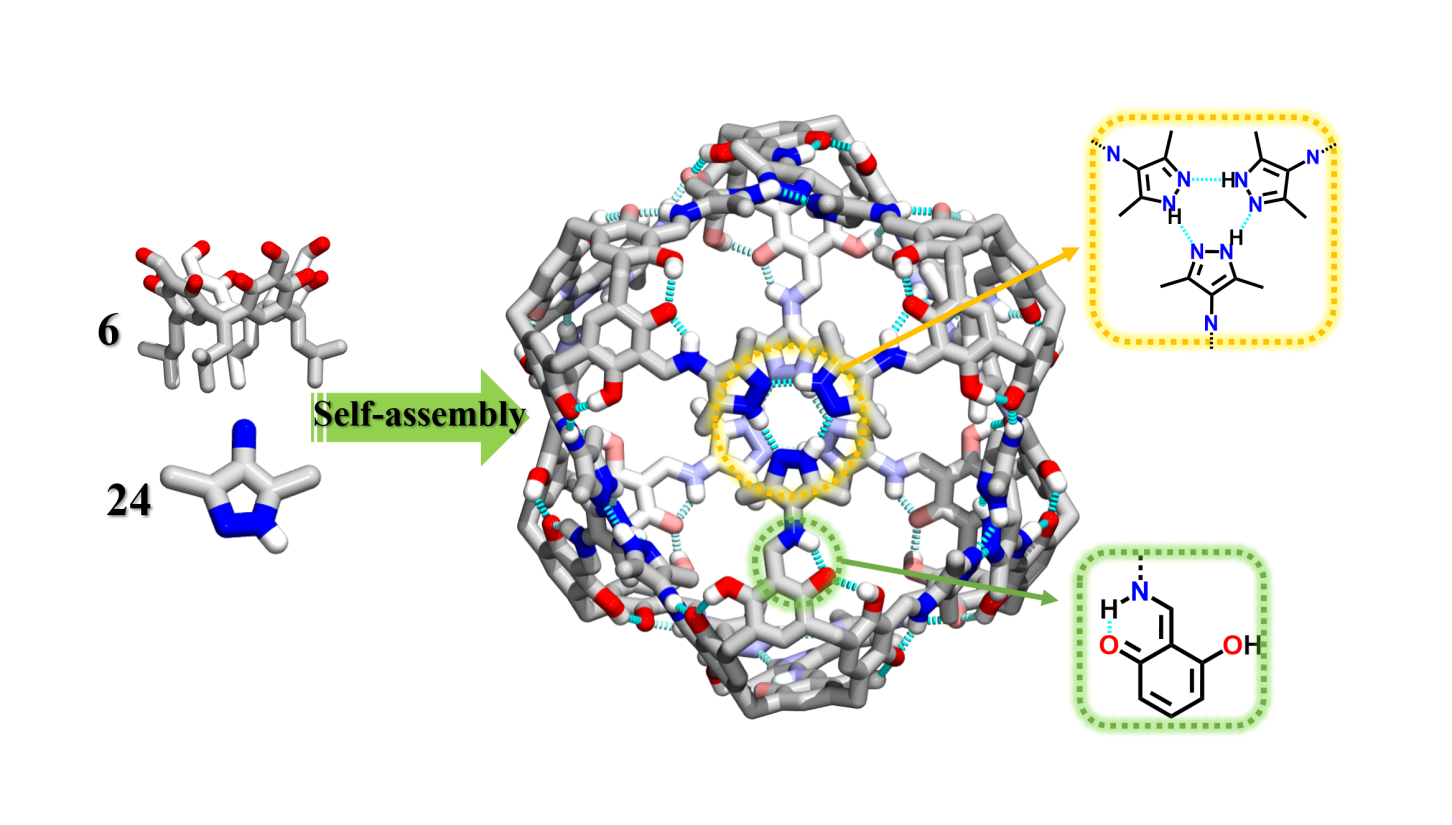
Schematic representation illustrating the constructing of HSC via synergistic covalent and hydrogen-bonding interactions. (Image by Prof. YUAN’s group)
Contact:
Prof. YUAN Daqiang
Fujian Institute of Research on the Structure of Matter
Chinese Academy of Sciences
Email:ydq@fjirsm.ac.cn
