Accurate state of health (SOH) estimation is essential for the safe operation of lithium-ion batteries in electric vehicles, energy storage systems, and smart battery management systems (BMS). With the increasing use of cloud platforms, vehicle networks, and remote monitoring interfaces, data-driven SOH models are becoming more exposed to cyber-physical security risks.
False data injection attacks (FDIAs) are a major threat to BMS. By subtly modifying voltage and current measurements, attackers may mislead SOH estimation models without producing obvious abnormal signals. Such stealthy manipulation can distort battery aging assessment, remaining useful life prediction, maintenance planning, and safety-related decision-making.
In a study published in Applied Energy,Dr. LIN Mingqiang’s group from Fujian Institute of Research on the Structure of Matter, Chinese Academy of Sciences, reported a reinforcement learning-driven adaptive stealthy attack framework named ReLASA for evaluating the vulnerability of data-driven SOH estimation models under FDIAs.
Researchers formulated the stealthy FDIA problem against SOH estimation as a Markov decision process. The framework trains an intelligent agent to generate continuous voltage-current perturbations according to battery degradation, model feedback, and detector responses. The research team used Soft Actor-Critic (SAC) to balance SOH manipulation effectiveness, multi-modal stealthiness, and physical constraint compliance.
To evaluate stealthiness more comprehensively, researchers integrated multiple detection and physical consistency indicators, including long short-term memory (LSTM) residuals, Hellinger distance, Kalman filter residuals, Ohm’s law violation, and voltage-current coupling error. These indicators examine whether the perturbed data remain statistically plausible, temporally consistent, and physically feasible.
Moreover, researchers validated ReLASA on a public MIT battery dataset and a self-built 18650 nickel manganese cobalt oxide (NMC) lithium-ion batteries. ReLASA was tested against multiple SOH estimation models, including multilayer perceptron (MLP), gated recurrent unit (GRU), LSTM, and convolutional neural network-LSTM (CNN-LSTM). Experimental results show that ReLASA can reliably manipulate SOH estimation trajectories while maintaining low detection residuals and physical-constraint violations.
Compared with generative adversarial network (GAN)-based attacks and projected gradient descent (PGD)-based attacks, ReLASA shows stronger cross-model adaptability and a better balance between attack effectiveness and stealthiness. The researchers found that the framework can maintain stable attack performance across different battery datasets and model architectures, indicating its value as a systematic adversarial testing tool.
This study provides an adversarial testing tool for identifying potential weaknesses in data-driven SOH estimation models. It also provides practical guidance for robust battery health estimation, anomaly detection, and cyber-physical defense in next-generation intelligent BMSs.
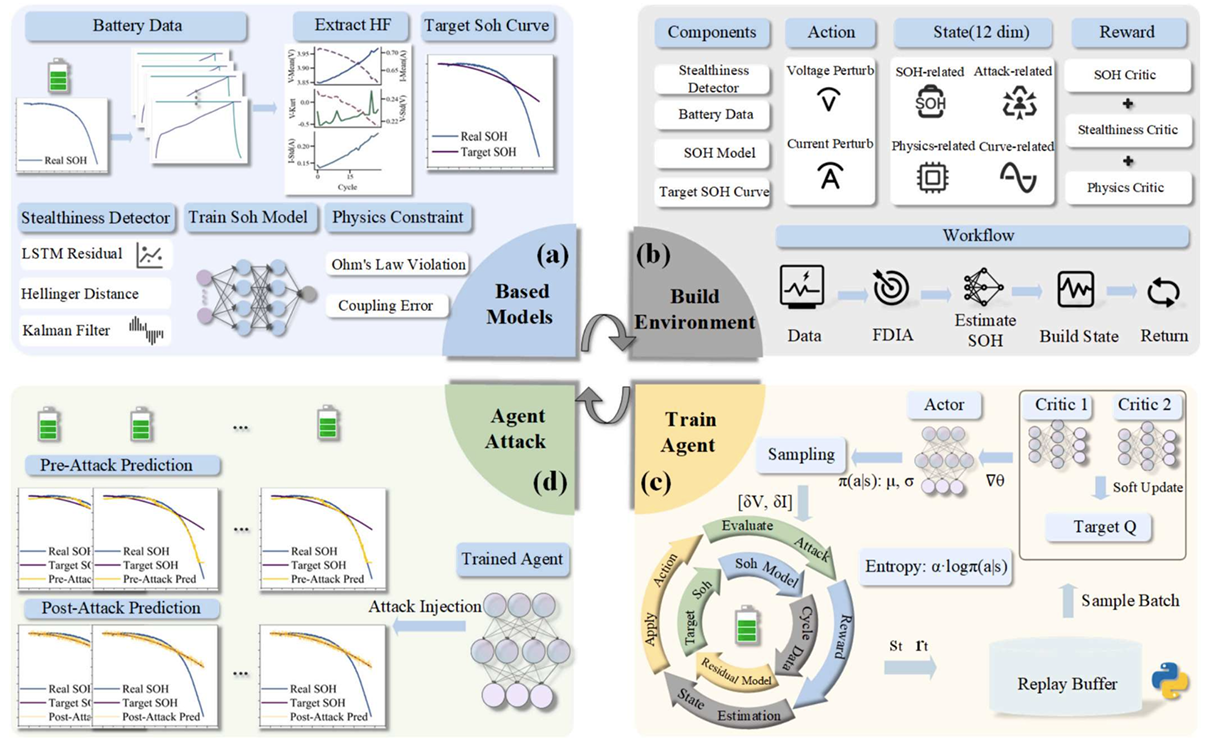
The ReLASA framework (Image by Dr. LIN Mingqiang’s group )
Contact:
Prof. LIN Mingqiang
Fujian Institute of Research on the Structure of Matter
Chinese Academy of Sciences
Email: kdlmq@fjirsm.ac.cn
