Persistent luminescence (PersL) in the second near-infrared window (NIR-II, 1000–1700 nm) holds immense promise for deep-tissue bioimaging and information storage owing to its superior light penetration and minimal background interference. However, current NIR-II PersL materials invariably rely on high-energy ultraviolet/visible light or hazardous X-rays for charging, severely limiting their in vivo applicability and practical utility.
In a study published in Materials Today , a research team led by Prof. CHEN Xueyuan and Prof. ZHENG Wei at Fujian Institute of Research on the Structure of Matter, Chinese Academy of Sciences, has developed a groundbreaking new class of NIR-I (700–1000 nm)-rechargeable multiwavelength NIR-II PersL phosphors.
The researchers engineered (Ln3+)-doped CaSnO3 via Bi2+ sensitization, enabling direct charging with tissue-penetrating, low-energy NIR-I photons. The core innovation is a tunneling-assisted upconversion-like trapping mechanism unveiled through detailed spectroscopic analysis. Unlike conventional charging, where UV/visible photons excite carriers into the conduction band for trap filling, the Bi2+ ions here serve as deep electron traps.
Upon NIR-I irradiation, stored electrons tunnel directly from these deep traps to adjacent shallow traps introduced by Ln3+ co-doping, completely bypassing the conduction band. This phonon-assisted tunneling effectively mimics an optical upconversion process but operates via a non-radiative charge migration pathway, enabling efficient storage of low-energy NIR-I photons.
By precisely regulating trap depth and distribution through Ln3+ doping, the team achieved intense, multiwavelength NIR-II PersL spanning 1000–1600 nm, with afterglow persistence exceeding 5 hours after a single NIR-I excitation.
Capitalizing on this NIR-I rechargeability, the researchers demonstrated CaSnO3:Bi2+/Ln3+ nanoparticles as reversible NIR-II PersL nanoprobes for subcutaneous optical information encoding and high-contrast deep-tissue imaging in mice. The system achieved an exceptional imaging depth of over 16 mm and a remarkable signal-to-background ratio of 19.
Crucially, the PersL can be non-invasively and repeatedly replenished in situ by simple NIR-I illumination, overcoming the single-use limitation of traditional PersL agents and enabling long-term dynamic monitoring.
This study establishes a new mechanistic paradigm for low-energy photon-driven PersL and charts a clear route toward next-generation smart luminescent materials. The NIR-I-rechargeable NIR-II PersL platform opens exciting opportunities for precision biomedicine, secure information encryption, and advanced anti-counterfeiting technologies.
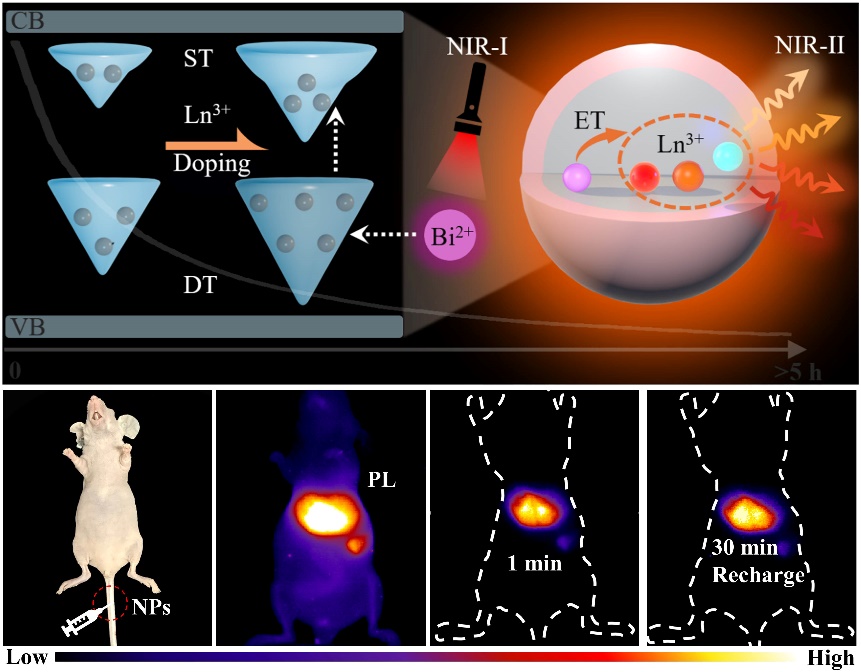
Schematic illustration of NIR-I rechargeable multiwavelength NIR-II persistent luminescence based on CaSnO3:Bi2+/Ln3+for deep-tissue bioimaging (Image by Prof. CHEN’s group)
Contact:
Prof. CHEN Xueyuan
Fujian Institute of Research on the Structure of Matter
Chinese Academy of Sciences
Email: xchen@fjirsm.ac.cn
