Nonlinear optical (NLO) crystals are essential materials for laser frequency conversion, enabling the generation of coherent light at wavelengths that are difficult to achieve directly with conventional lasers. As such, they play a critical role in communication and precision manufacturing applications. However, commercially available infrared (IR) NLO crystals such as AgGaS2, AgGaSe2, and ZnGeP2, despite exhibiting relatively high NLO coefficients and broad transmission ranges, suffer from either low laser-induced damage thresholds (LIDT) or significant two-photon absorption, which severely limits their applicability in high-power laser systems.
Although noncentrosymmetry is an essential prerequisite for second-order nonlinear optical effects, achieving it remains synthetically challenging. To date, the flux method has seldom been utilized to induce a transition from centrosymmetric to noncentrosymmetric structure.
In a study published in Small, a research team led by Professors GUO Guocong and LIU Binwen from the Fujian Institute of Research on the Structure of Matter, Chinese Academy of Sciences, reported a strategy for synthesizing high-performance IR NLO materials via flux-induced symmetry breaking.
Starting from the known centrosymmetric phase β-Ba2Ge4S10, researchers synthesized its noncentrosymmetric phase α-Ba2Ge4S10 using a lower-temperature (900 °C) flux-growth method under a sealed system. A variety of fluxes, including alkali metal halides, alkaline-earth metal halides, and transition metal iodides, were found to yield the target product. Remarkably, by optimizing the growth conditions with a NaI flux, the team obtained millimeter-sized single crystals up to 10 × 4 × 4 mm3, paving the way for detailed property characterization and practical device integration.
Structural analysis revealed that α-Ba2Ge4S10 crystallizes in the noncentrosymmetric space group I-42d, featuring a zero-dimensional T2-supertetrahedral [Ge4S10]4– clusters linked by Ba2+ cations. Compared with the β phase, α-Ba2Ge4S10 exhibits significantly larger distortions in both the [Ge4S10]4– clusters and the Ba2+ coordination environments. Along the crystallographic c-axis, the Ge–S framework in the α phase displays a pronounced twisted configuration, whereas that in the β phase remains nearly parallel. Bond strain index and global instability index calculations indicate that α-Ba2Ge4S10 is a metastable phase, which rationalizes its formation under the lower-temperature flux conditions.
Optically, α-Ba2Ge4S10 demonstrates outstanding combined performance. It possesses a wide optical bandgap of 3.15 eV, substantially larger than those of commercial AgGaS2 (2.62 eV) and AgGaSe2 (1.72 eV). Under 2050 nm laser excitation, its powder second-harmonic generation (SHG) response reaches 1.2 times that of AgGaS2, with phase-matchable behavior. The single-crystal IR transmission ranges from 2.5 to 12.8 μm, fully covering both the 3–5 μm and 8–12 μm atmospheric windows. Moreover, its LIDT is as high as 442.7 MW/cm2, approximately 14.8 times that of AgGaS2. First-principles calculations further reveal that the microscopic origin of the SHG effect is mainly attributable to strong covalent interactions between S and Ge atoms within the [Ge4S10] clusters.
This study demonstrates the first example of an NLO material based on T2-[Ge4S10] clusters and successfully achieves a centrosymmetric to noncentrosymmetric phase transition via a flux method. α-Ba2Ge4S10 displays a compelling set of NLO characteristics: a wide band gap (3.15 eV), favorable SHG response (1.2 × AGS), phase-matching behavior, high LIDT (14.8 × AGS), a broad infrared transmission window (2.5–12.8 µm), and good physicochemical stability. This discovery not only advances the field of IR NLO crystalline materials but also offers a promising route for designing advanced functional materials.
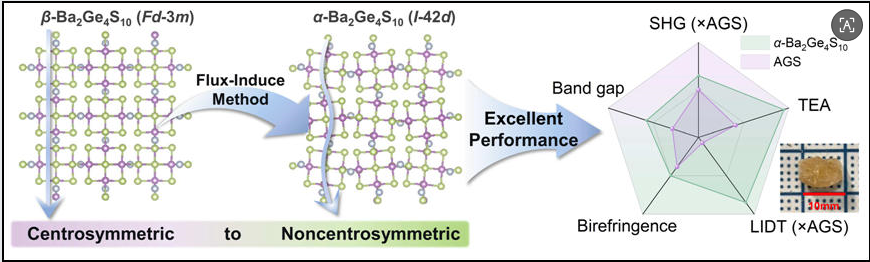
A Design Strategy for High-Performance α-Ba2Ge4S10 via Flux-Induced Symmetry Breaking. (Image by Prof. GUO's group)
Contact:
Prof. GUO Guocong
Fujian Institute of Research on the Structure of Matter
Chinese Academy of Sciences
Email: gcguo@fjirsm.ac.cn
