Lightweight lattice metamaterials face critical brittle failure risks under bending loads due to severe stress concentration, limiting their engineering application. The natural cross-lamellar structure of Strombus gigas (queen conch) shell delivers outstanding toughness via multi-scale stress redistribution, offering a promising biomimetic solution to this challenge.
In a study published in Thin-Walled Structures, the research team led by Dr. YANG Yongtai from Fujian Institute of Research on the Structure of Matter, Chinese Academy of Sciences, created a novel cross-lamellar lattice metamaterial with layerwise stiffness tuning for superior anti-fracture performance.
Inspired by conch shell lamellar stacking rules, the researchers designed orthogonal-orientated lattice unit cells. Three multi-layer configurations (y-x-y, y-y-y, x-y-x) were fabricated via vat photopolymerization additive manufacturing using PC20 photopolymer resin, with classic Octet lattice as the control group.
Quasi-static three-point bending and Single-edge notched bending (SENB) tests, combined with Finite element (FE) simulations, the researchers verified the mechanical performance of all designs.
Monolayer tests revealed two distinct mechanical modes: y-type lattices possess high stiffness yet brittle fracture, while x-type lattices show great ductility and large deformation capacity.
Among three-layer notched specimens, the y-x-y layout (rigid outer layers + compliant intermediate layer) shows the optimal toughening effect. Its J-integral reaches 8.45 kJ/m², twice that of uniform y-y-y lattices and over 20 times higher than Octet lattice. The middle compliant layer redistributes stress, delays crack initiation and extends stable deformation range significantly.
The alternating strut orientation and layered stiffness gradient of the y-x-y structure replicate the shell’s natural toughening mechanism, alleviating stress concentration and promoting sustained plastic energy dissipation. This advantage remains stable across relative densities from 17.5% to 32.5%.
This study provides a clear biomimetic design guideline for high-toughness lightweight metamaterials, with wide application prospects in aerospace thin-walled components and protective energy-absorbing structures.
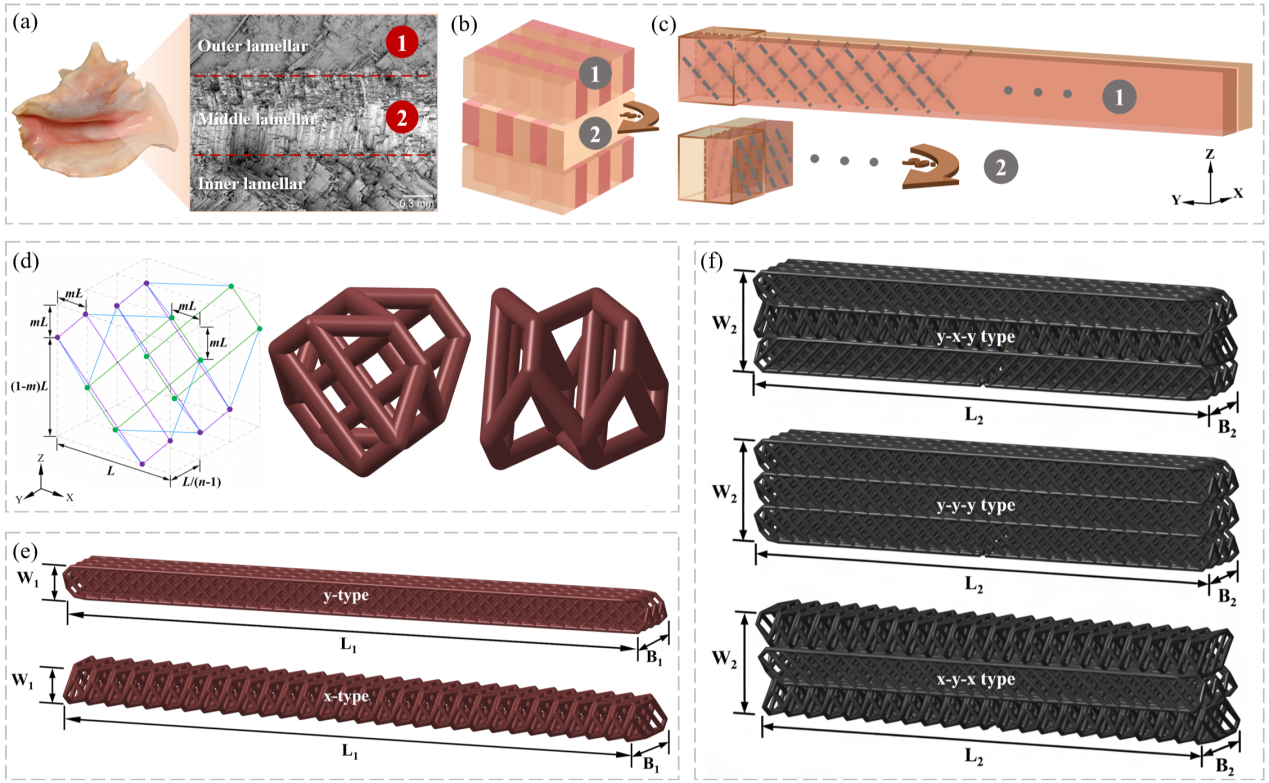
3D printed monolayer and three-layer bio-inspired lattice specimens and Octet reference samples (Image by Dr. YANG’s group)
Contact:
Dr. YANG Yongtai
Fujian Institute of Research on the Structure of Matter
Chinese Academy of Sciences
Email: yangyongtai@fjirsm.ac.cn
