Accurate pressure measurement under extreme conditions is essential for probing structural evolution and pressure-induced phenomena in condensed-matter physics and materials science. However, conventional optical manometers often require ultraviolet excitation, which may be limited by relatively low pressure sensitivity, high cost of UV lasers, and spectral interference from background fluorescence.
In a study published in Advanced Materials, the research group led by Prof. CHEN Xueyuan from Fujian Institute of Research on the Structure of Matter of the Chinese Academy of Sciences (CAS), in collaboration with Prof. QUAN Zewei’s group at Southern University of Science and Technology, has developed a novel class of ultrasensitive pressure-responsive upconversion luminescent manometer based on Yb3+/Mn2+ co-doped Cs2NaBiCl6 double perovskites.
Researchers leveraged the soft lattice characteristics of Cs2NaBiCl6 to achieve pressure-sensitive upconversion luminescence of Mn2+ through Yb3+ sensitization. Under 980 nm excitation, Yb3+ efficiently absorbs near-infrared light and transfers energy to Yb3+–Mn2+ dimers, generating yellow broadband upconversion emission centered at 586 nm. Because Mn2+ emission is highly susceptible to the local crystal field environment, its 3d energy levels respond sensitively to pressure-induced changes in the local crystal-field environment. The soft lattice of Cs2NaBiCl6 further amplifies the pressure-induced modulation of the Mn2+ local environment, substantially enhancing the spectral response sensitivity.
Within the pressure range of 0–7.19 GPa, the material exhibited a continuous red shift of the emission spectrum and clearly discernible luminescence color changes. The emission band centroid displayed an excellent linear relationship with pressure, achieving a sensitivity of 15.03 nm/GPa, which is the highest sensitivity among visible-light pressure sensors with a linear response.
In situ high-pressure X-ray diffraction revealed that Cs2NaBiCl6:Yb3+/Mn2+ maintained good structural stability during compression, with a bulk modulus of only 23.69 GPa, indicating high compressibility that underpins its exceptional pressure sensitivity. In situ Raman spectroscopy and pressure cycling tests further confirmed its excellent stability and reproducibility.
This study integrates near-infrared excitation with highly sensitive pressure-responsive luminescence, offering a novel materials design strategy for high-precision optical pressure sensing. With its linear response, high sensitivity, visual readout, and robust cycling stability, the material shows promise for precision pressure monitoring in high-pressure physics, deep-sea exploration, and simulations of conditions in Earth’s and planetary interiors.
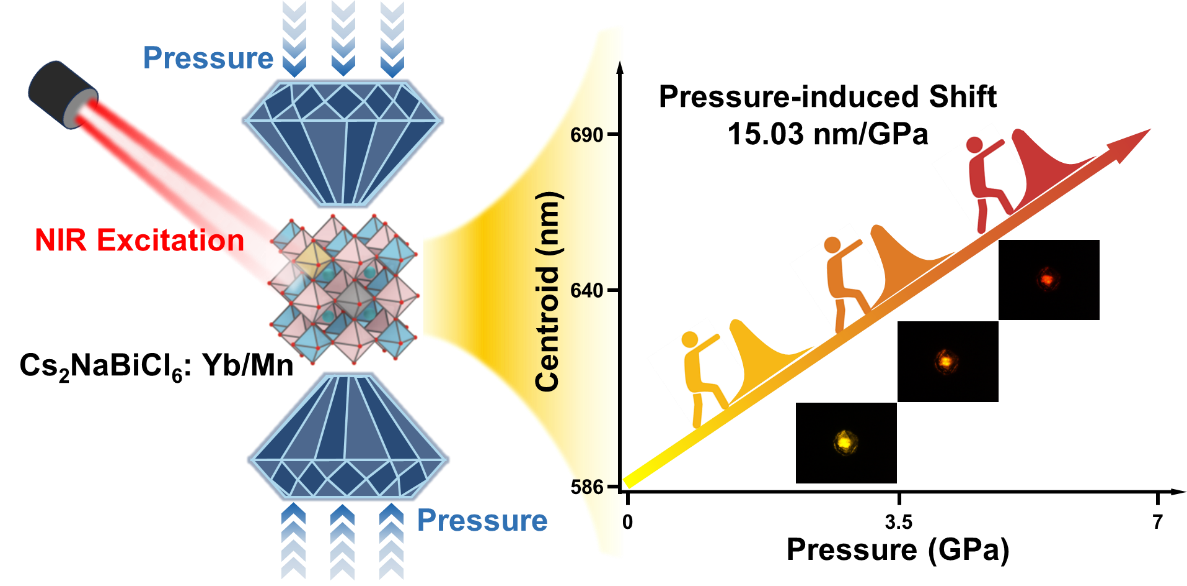
Schematic diagram of ultrasensitive pressure-responsive upconversion luminescent manometer based on Cs2NaBiCl6:Yb3+/Mn2+ double perovskite (Image by Prof. CHEN’s group)
Contact:
Prof. CHEN Xueyuan
Fujian Institute of Research on the Structure of Matter
Chinese Academy of Sciences
Email: xchen@fjirsm.ac.cn
