Molecular-based crystalline conductors provide an ideal platform for exploring the relationship between molecular organization and electronic properties, owing to their highly ordered crystal structures and precisely defined molecular architectures. However, unlike conductive metal–organic frameworks (MOFs) and covalent organic frameworks (COFs), in which multidimensional molecular building blocks can establish continuous charge-transport pathways, zero-dimensional (0D) cluster-based materials typically consist of discrete and isolated molecular units. The absence of effective long-range charge-transfer pathways within these isolated clusters has therefore remained a major challenge for achieving high intrinsic electrical conductivity.
In a study published in Nature Synthesis, research teams lead by Prof. FANG Weihui and Prof. XU Li from Fujian Institute of Research on the Structure of Matter, Chinese Academy of Sciences, have developed a new strategy to address this challenge by introducing electron-rich aromatic {MoIV3-py3} metal-cluster building blocks. This approach enables the construction of dimeric molecular conductors in which previously isolated clusters are interconnected through novel d–π···π–d conjugated pathways. By establishing extended charge-transport channels between discrete molecular clusters, this design substantially enhances electronic conduction within the cluster-based material.
The incorporation of different rare-earth ions into the cluster frameworks further enables precise control over the crystal structures and electronic properties. Two distinct crystalline phases were obtained: a hexagonal phase exhibiting semiconducting behavior and a tetragonal phase featuring metallic characteristics. This rare-earth-directed structural regulation also provides an effective means of tuning electrical anisotropy in single-crystalline molecular materials.
The introduction of the electron-rich aromatic {MoIV3-py3} building blocks established dimeric molecular conductors with the first example of intercluster d–π···π–d conjugated transport pathways, and significantly enhances electrical conduction along the ab plane. As a result, conductivity cluster-based crystalline materials exhibit pronounced electrical anisotropy, with conductivity along the ab direction generally exceeding that along the c direction. In particular, Sm- and Eu-containing hexagonal crystals exhibit strong π···π interactions and achieve conductivities of approximately 3×10⁻⁵ S m⁻1 along the ab direction, representing an enhancement of five orders of magnitude compared with conventional polyoxometalate-based materials.
The rare-earth ions also play a crucial role in regulating charge transport along different crystallographic directions. Across the La–Gd series of hexagonal crystals, the conductivity along the ab direction correlates closely with the strength of the π···π interactions, whereas charge transport along the c direction is primarily influenced by the electronic energy gaps of the cluster units. Notably, the choice of rare-earth ion can introduce additional redox-mediated transport pathways. In Eu-containing crystals, efficient EuII/EuIII redox processes substantially enhance charge transport along the c direction, bringing it to a level comparable to that along the ab plane and resulting in nearly isotropic electrical conduction. In contrast, Ce-containing crystals exhibit reversed electrical anisotropy. The weaker π···π interactions suppress charge transport within the ab plane, while CeIII/CeIV-associated redox pathways facilitate charge transport along the c direction, making the conductivity along this direction approximately one order of magnitude higher than that along the ab direction.
Computational studies further reveal that the dimeric aromatic cluster assemblies in the tetragonal phase possess smaller molecular energy gaps than those in the hexagonal phase, consistent with the higher electrical conductivity observed for the tetragonal materials. Periodic electronic-structure calculations demonstrate that the rare-earth-controlled hexagonal and tetragonal phases exhibit distinct electronic structures, corresponding to semiconducting and metallic behavior, respectively. These results provide theoretical support for the d–π···π–d charge-transport pathway and demonstrate that the electronic states of cluster-based crystalline materials can be regulated through rare-earth-directed structural assembly.
This study establishes a strategy for transforming isolated molecular clusters into interconnected conductive networks and demonstrates how the structural organization of cluster building blocks can be coupled with rare-earth-mediated electronic regulation. The approach provides a versatile platform for designing cluster-based crystalline materials with controllable charge-transport properties, including electrical anisotropy and semiconductor-to-metal electronic behavior.
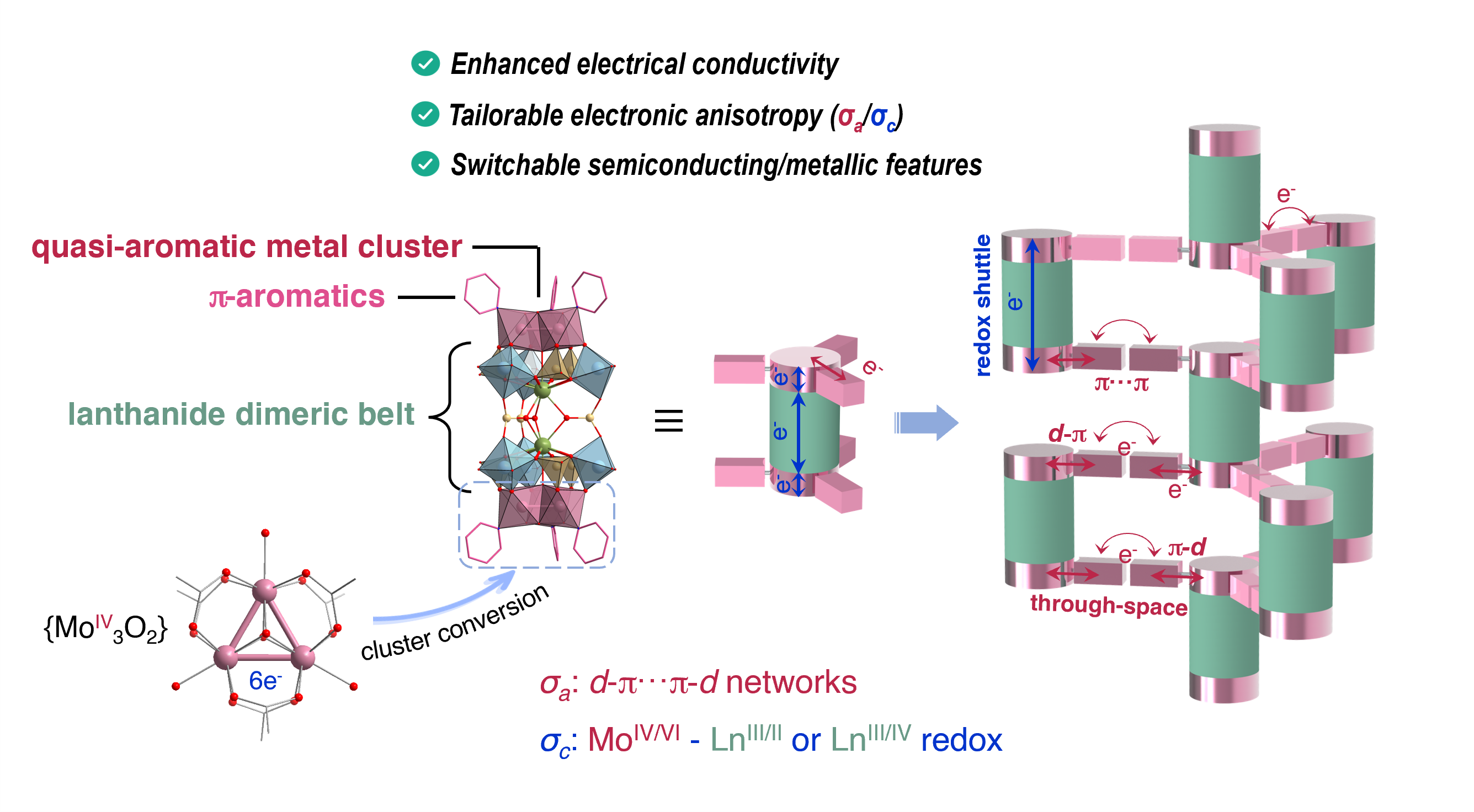
Schematic illustration of rare-earth-directed assembly toward conductive 3D molecular-cluster networks(Image by Prof. FANG’s group)
Contact:
Prof. FANG Weihui
Fujian Institute of Research on the Structure of Matter
Chinese Academy of Sciences
Email: fwh@fjirsm.ac.cn
