Noninvasive monitoring of cortisol is important for characterizing circadian regulation and physiological responses to exercise and stress. Sweat has provided an alternative to laboratory testing, but existing wearable cortisol platforms often rely on complex microfluidic collectors, electronic readout modules, or dedicated instruments. It is needed to integrate rapid sweat acquisition, selective molecular recognition, stable attachment to wet skin, and portable signal readout within a single platform.
In a study published in Biosensors and Bioelectronics, a team led by Prof. ZHANG Yun from the Fujian Institute of Research on the Structure of Matter of the Chinese Academy of Sciences developed a flexible multilayer wood-derived hydrogel patch that integrates capillary-driven sweat collection, fluorescence-based cortisol recognition, wet-skin adhesion, and smartphone-assisted analysis.
Researchers removed lignin from balsa wood and preserved its aligned multiscale channels. They then infiltrated the scaffold with a polyacrylamide/poly(vinyl alcohol)/glycerol hydrogel and functionalized with a UCNP-apt/cDNA-Au probe.
The resulting flexible, skin-conformal patch retained continuous capillary pathways for pump-free sweat transport, achieving a peak water absorption rate of 0.0539 g·s-1 and directional bottom‑to‑top transport within ~0.03 s. An adhesive layer enhanced wet-skin adhesion, while an ultrathin polyethylene terephthalate film improved water retention and fluorescence stability.
Tests of the patch showed that he normalized green fluorescence intensity was linearly correlated with the logarithm of cortisol concentration from 1 pM to 1 μM, with a distinguishable response at the lowest tested concentration of 1 pM in human sweat. Repeatability and spike-and-recovery tests, together with the agreement with enzyme‑linked immunosorbent assay and liquid chromatography‑tandem mass spectrometry, supported its analytical reliability.
Researchers developed the "VisCor" smartphone application for portable quantification. After a 30-min wearing period, the patch was excited using a 980 nm laser, and its 541 nm emission was collected off-body through a narrow-band filter. Device-dependent variation was reduced by ratiometric self-calibration and optical readout could be completed within 2 h after sampling.
Pilot human studies supported interval profiling of exercise-associated, diurnal, longitudinal, and inter-individual variations in sweat cortisol, although validation in larger controlled cohorts is still required.
This study extends wood-derived materials into wearable biosensing, and provides a bio-derived integration strategy for portable biochemical analysis.
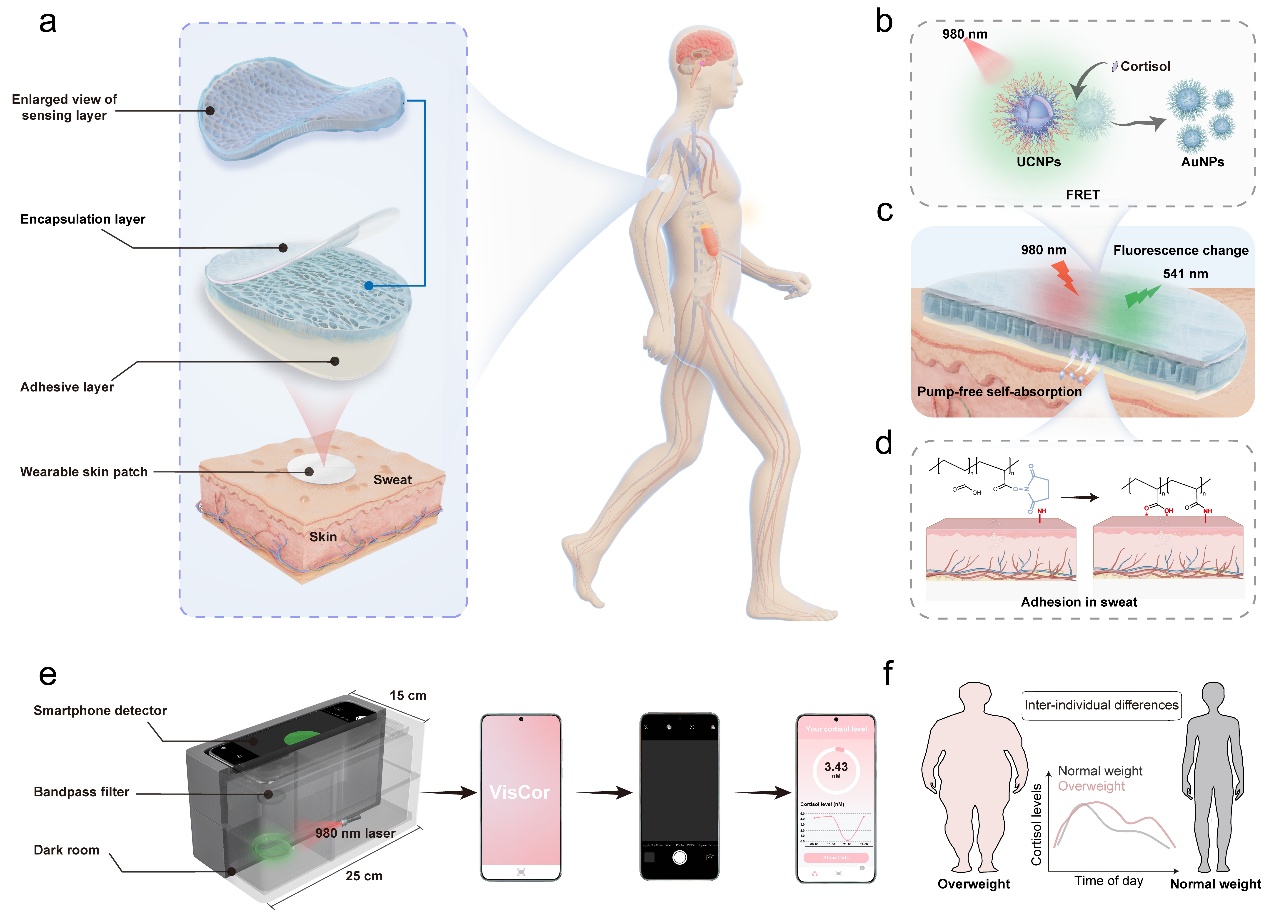
Design and application of the multilayer wood-derived hydrogel patch, including (a) patch architecture, (b) fluorescence-based cortisol recognition, (c) pump-free sweat uptake, (d) wet-skin adhesion, (e) smartphone-assisted readout, and (f) pilot interval cortisol profiling (Image by Prof. ZHANG Yun's group)
Contact:
Prof. ZHANG Yun
Fujian Institute of Research on the Structure of Matter
Chinese Academy of Sciences
Email:zhangy@fjirsm.ac.cn
