Research
  Key Laboratories
  Research Divisions
  Research Interests
  Supporting System
  Achievements
  Research Progress
  Research Programs
  Technology Transfer
    Location: Home > Research > Research Progress

Researchers Introduce Dual-hierarchy Learning for Few-shot 3D Point Cloud Classification

Few-shot learning (FSL) aims to recognize previously unseen categories from only a small number of labeled examples, offering a practical solution when large-scale annotation is difficult or costly. However, extending FSL to three-dimensional (3D) point clouds remains challenging because point clouds are unordered and irregular, while large, well-annotated 3D datasets are relatively limited. These characteristics make it difficult for conventional feature learning methods to fully exploit the geometric structure of point cloud data.

A research team led by Prof. CHAO Jianshu from the Fujian Institute of Research on the Structure of Matter, Chinese Academy of Sciences, has developed DHNet, a dual-hierarchy learning framework for few-shot 3D point cloud classification. The study introduces the concept of dual-hierarchy and jointly models hierarchical structures at the patch and object levels. The research was published in Knowledge-Based Systems.

The researchers observed that point clouds contain hierarchical structures at two complementary levels. At the patch level, local geometric components are composed of structurally related patches, while at the object level, different instances can share a common semantic category and exhibit relationships among related classes. The team therefore designed DHNet to exploit these geometric priors rather than treating all representations within a conventional Euclidean feature space. Hyperbolic geometry is adopted because it is well suited to represent hierarchical relationships.

The first component, PHFormer, is a Transformer-based embedding network designed to capture patch-level hierarchy. The method first partitions an input point cloud into local patches using Farthest Point Sampling (FPS) and k-nearest neighbor (KNN) grouping. Each normalized patch is then encoded by a lightweight mini-PointNet, while positional information is introduced through a small learnable network. The resulting patch sequence is processed by a hierarchy attention mechanism that enables information exchange among structurally related local regions.

To better reflect hierarchical geometry in the attention process, the proposed hierarchy attention maps the query and key representations into hyperbolic space and calculates their relationships using hyperbolic distance. The value representation remains in Euclidean space, simplifying the aggregation process. This design allows PHFormer to emphasize structural similarities among local patches while retaining an efficient feature aggregation pathway.

The second component, HyperHead, addresses the object-level hierarchy during few-shot classification. Following the metric-based few-shot learning paradigm, the support and query features produced by PHFormer are mapped onto a Poincaré ball. Class prototypes are constructed through tangent-space averaging and mapped back to the hyperbolic manifold. The geodesic distance between a query and each class prototype is then used for classification, enabling object-level relationships to be modeled directly in a non-Euclidean space.

Extensive experiments were conducted on four benchmark datasets—ModelNet40, ModelNet40-C, ShapeNet70, and ScanObjectNN—under standard 5-way 1-shot and 5-way 5-shot settings. DHNet achieves the best performance in 7 of 8 evaluated scenarios. On ModelNet40, it reaches 84.53% and 89.97% accuracy in the 1-shot and 5-shot settings, respectively. On ShapeNet70, the 5-way 1-shot accuracy improves from 76.07% with the previous best method to 80.48%, a gain of 4.41 percentage points. On ModelNet40-C, DHNet achieves a 2.28-point advantage in the 5-way 1-shot setting, demonstrating improved robustness to point-cloud corruption.

Ablation studies further showed that hierarchy attention and HyperHead provide complementary benefits, as their combination consistently outperforms either module alone across all datasets and settings, with the largest gains over baseline (e.g., +19.74% on ModelNet40-C 1-shot and +16.02% on ModelNet40 1-shot) while each individually also improves performance, confirming their synergistic effectiveness in DHNet for few-shot 3D recognition. Feature visualizations also show that PHFormer produces locally consistent representations for geometric components, while HyperHead yields more globally organized and semantically oriented features, providing visual evidence for the proposed patch-level and object-level hierarchy modeling.

This study demonstrates that explicitly modeling the dual-hierarchy inherent in 3D point clouds can improve data-efficient representation learning. By combining hierarchy-aware Transformer features with hyperbolic prototype-based classification, DHNet provides a unified approach for exploiting local geometric structure and global semantic relationships. The findings offer a promising direction for few-shot 3D perception, particularly in settings where labeled point-cloud data are scarce.
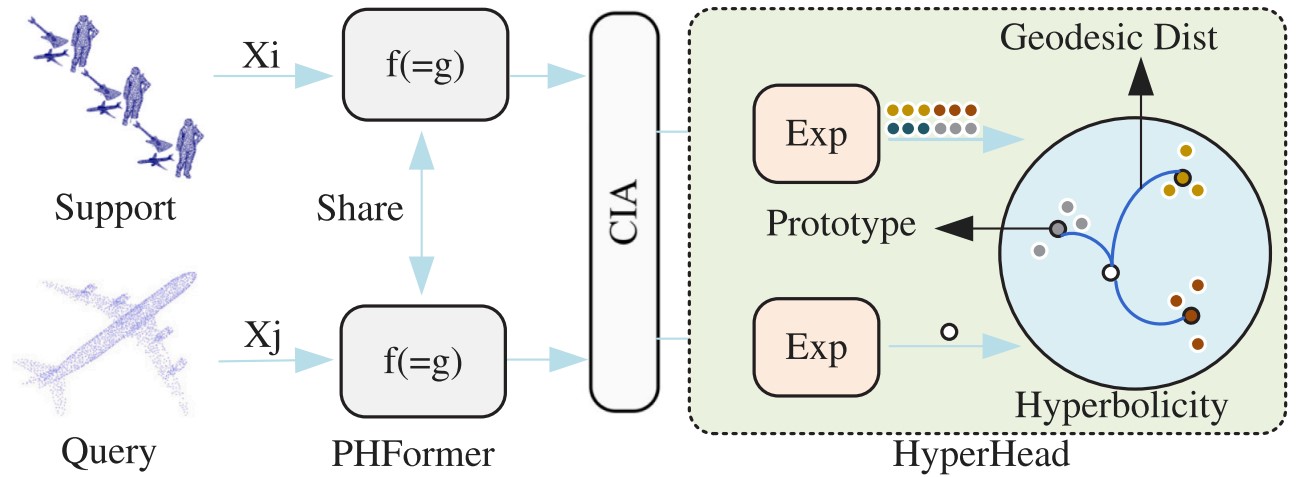
Illustration of the Research (Image by Prof. CHAO’s group)


Contact:

Prof. CHAO Jianshu

Fujian Institute of Research on the Structure of Matter

Chinese Academy of Sciences

Email:jchao@fjirsm.ac.cn


Keywords: Few-shot learning, Hierarchy attention, Point cloud classification, Hyperbolic geometry

Published Paper Title: DHNet: Dual-hierarchy geometric learning with hyperbolic embeddings for few-shot point cloud classification

Link:https://doi.org/10.1016/j.knosys.2026.116836


Fujian Institute of Research on the Structure of Matter, Chinese Academy of Sciences
Address: No.8, Gaoxindadao Road, Shangjie, Minhou, Fuzhou, P. R. China Postcode: 350108 Tel: 0591-63173066 Fax: 0591-63173068 E-mail: fjirsm@fjirsm.ac.cn
Copyright @ 2000-2009 fjirsm. All rights reserved.