Diacetylene-based metal-organic frameworks (MOFs) are promising candidates for nonlinear optical (NLO) materials due to their π-conjugated systems and unsaturated sites, which can undergo 1,4-addition topochemical polymerization, significantly enhancing the conjugation and functionality of the materials. However, achieving precise control over this polymerization remains a huge challenge because most reported diacetylene MOFs lack the stringent molecular alignment and ordered stacking required for the reaction.
In a study published in the Angewandte Chemie International Edition, the research team led by Prof. ZHANG Jian and Prof. GU Zhigang from Fujian Institute of Research on the Structure of Matter of Chinese Academy of Sciences has reported a groundbreaking strategy that uses interpenetration transformation to enable topochemical polymerization in diacetylene MOFs.
The researchers synthesized two interpenetrated MOFs from a diacetylene ligand and Zn nitrate: a twofold interpenetrated CAS-20 and a threefold interpenetrated CAS-22. Through crystallographic analysis and detailed spectroscopic characterization, they systematically unveiled that the interpenetration transformation from CAS-20 to CAS-22 proceeds through a set of non-interpenetrated semi-crystalline intermediates (CAS-20-d, CAS-21, CAS-21-d) accompanied by guest loss. This semi-crystalline state is driven by non-synchronous transformations of two individual frameworks in interpenetrated CAS-20, jointly revealed through crystallographic analysis and detailed spectroscopic characterization.
Remarkably, this interpenetration transformation promotes the diacetylene groups to arrange in a suitable ordered and continuous stacking manner, enabling thermally induced topochemical polymerization in CAS-22 via a 1,4-addition reaction. The results confirm that the obtained interpenetrated MOFs show classic nonlinear optical limiting performance, and the polymerized CAS-22 exhibits a remarkably enhanced third-order nonlinear absorption coefficient compared to CAS-20 (~69 times). Femtosecond Z-scan measurements further demonstrate ultra-broadband reverse saturable absorption from the visible to the near-infrared region, positioning CAS-22-heat as a rare femtosecond optical limiting material.
This study pioneers interpenetration transformation as a novel strategy for realizing MOF topochemical polymerization, opening new avenues for designing high-performance optoelectronic materials for smart sensing and laser protection applications.
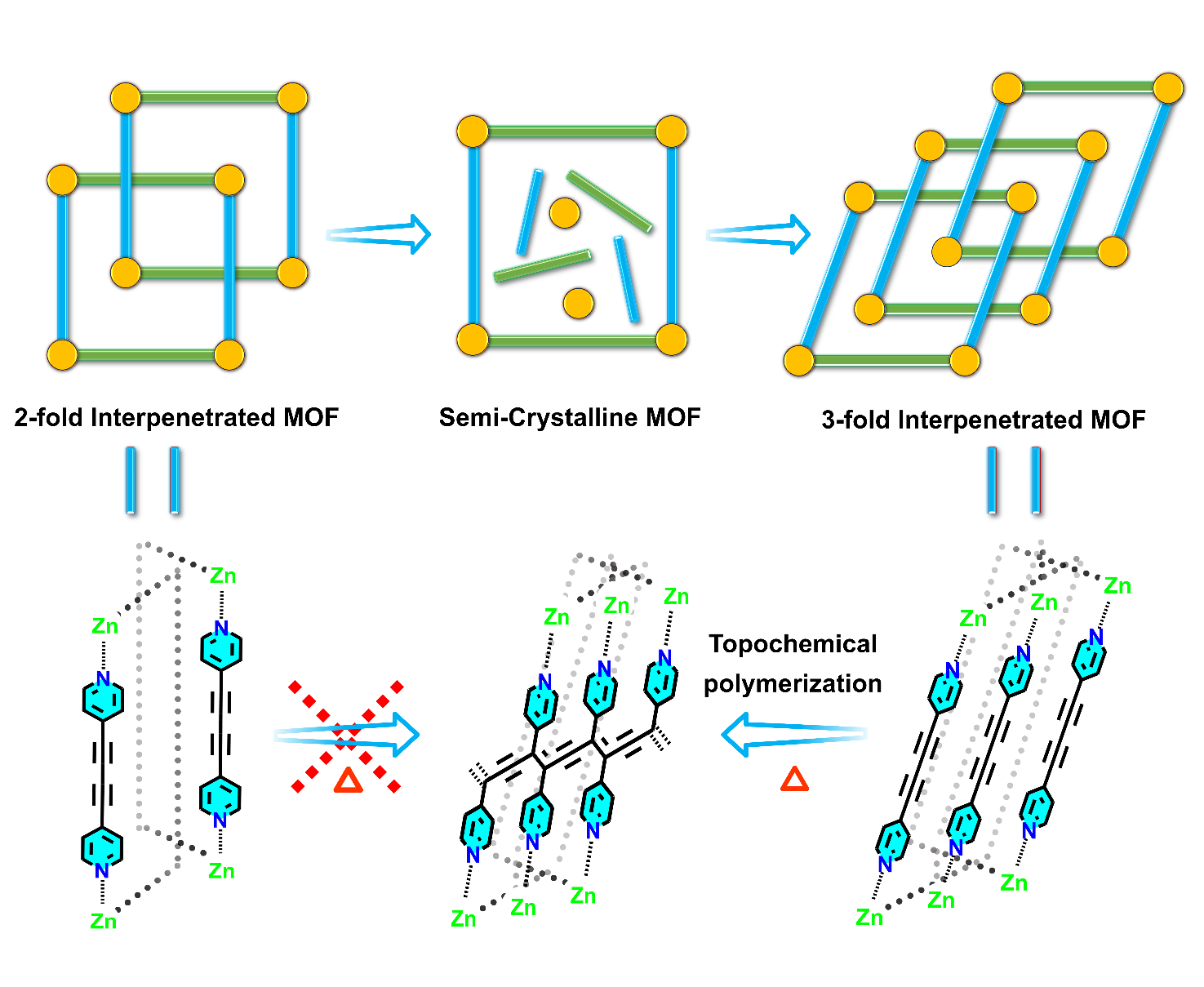
Interpenetration transformation from twofold interpenetrated CAS-20 to threefold interpenetrated CAS-22 via semi-crystalline intermediates, enabling topochemical polymerization.(Image by FJIRSM)
Contact:
Prof. GU Zhigang
Fujian Institute of Research on the Structure of Matter
Chinese Academy of Sciences
Email: zggu@fjirsm.ac.cn
