With the development of integrated optics, birefringent materials urgently need to shift from bulk crystals to film form. However, when traditional birefringent materials are transformed from bulk crystals to films, their performance significantly deteriorates. Their optical anisotropy usually retains only about 20% of that of the bulk crystals, which severely restricts the application of films in integrated photonic devices.
Organic metal chalcogenides (OMCs) synthesized through coordination chemistry represent a new type of two-dimensional van der Waals (2D-vDW) material, with a structural feature of alternating inorganic layers and organic layers forming a "molecular-scale superlattice". OMCs exhibit strong structural anisotropy due to the significant difference between in-plane covalent bonding and out-of-plane van der Waals interactions. And their processability in solution-based methods provides an effective way to prepare high-quality films.
In a study published in the Angewandte Chemie International Edition, the research team led by Prof. XU Gang from Fujian Institute of Research on the Structure of Matter of Chinese Academy of Sciences has reported an OMC birefringen film, maintaining 77% of the birefringence of its bulk crystal.
Researchers synthesized the noncentrosymmetric PbHBT crystals via solvothermal method. The crystal structure of PbHBT is primarily composed of an alternating stack of PbS inorganic layers and -Ph-OH organic layers. The inorganic PbS layers covalently anchored by the -Ph-OH organic group through S-C covalent bond. These -Ph-OH decorated PbS layers are further stacked along the c-axis via van der Waals interactions between the adjacent organic groups, ultimately affording the 3D layered architecture of PbHBT. By constructing PbHBT, researchers show that the periodic molecular-scale superlattice of inorganic and organic layers gives rise to strong anisotropic electron distribution, yielding a bulk birefringence of 0.39 at 546 nm.
The researchers employed thein-situ spin-coating layer-by-layer liquid-phase epitaxy enabled by coordination chemistry, each growth cycle achieves self-limiting, self-healing assembly at the molecular scale, producing films with ~1.3 nm thickness control, high crystallographic orientation, and no obvious defects. This films achieve a birefringence of 0.65 in the visible region and 0.43 in the near-infrared, surpassing all existing films and commercial crystals. In addition, the birefringence of the PbHBT film is 0.3 at 546 nm. The optical anisotropy retained 77% of that of bulk crystals.
This work establishes OMCs as a general platform for high-birefringence films. Unlike conventional materials that lose anisotropy upon film formation, OMCs retain molecular-scale order through coordination chemistry and liquid-phase assembly—a principle that extends beyond PbHBT to the entire OMC family. This research has opened up a new path for the development of double refractive film materials with large intrinsic birefringence and high retention rate, effectively bridging the performance gap between bulk and film materials.
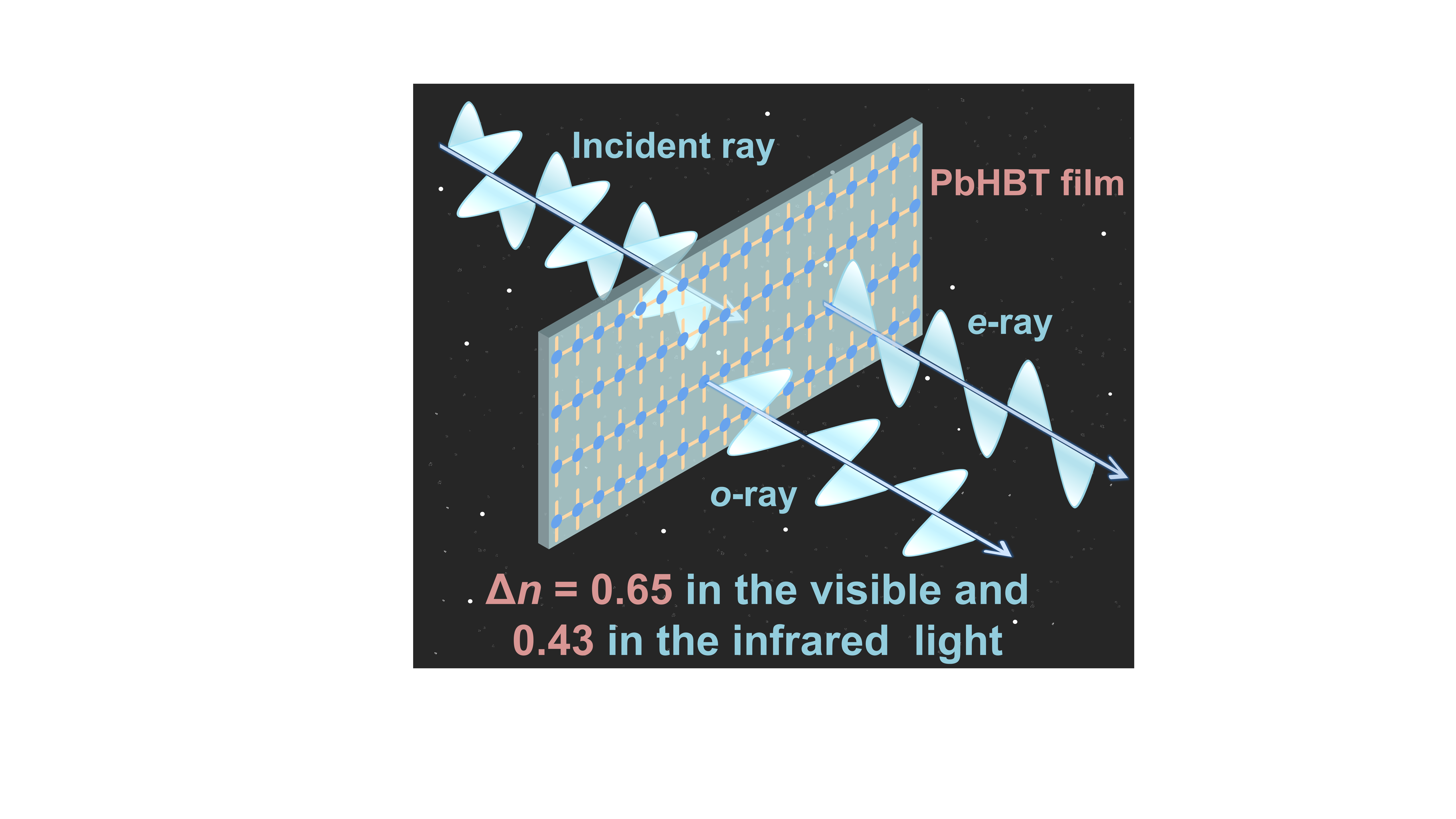
Organic metal chalcogenide PbHBT film with giant birefringence. (Image by Prof. XU's group)
Contact:
Prof. XU Gang
Fujian Institute of Research on the Structure of Matter
Chinese Academy of Sciences
Email: gxu@fjirsm.ac.cn
